Pius IX is a blessed of the Catholic Church (1792 - 1878). Pius IX's feast day is celebrated on 7 February.
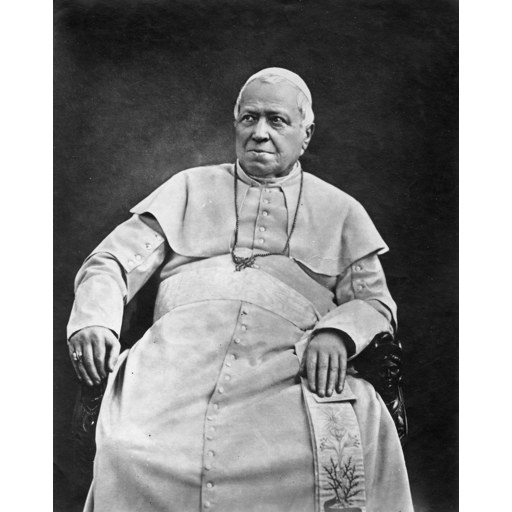
Adolphe Braun
License: Public domain
Pius IX
Blessed- Life Span
- 1792 - 1878 (age 86)
- Feast Day
- 7 February
- Gender
- male
- Church
- Catholic
Places
Relics & Where to Venerate
Location unknown
The bodily remains of Pius IX are a first-class relic. Venerated at Tomb of Pius IX.
Roles & Family
Canonization
Biography
Pope Pius IX was born Giovanni Maria Mastai-Ferretti on 13 May 1792 in Senigallia, a coastal town in the Papal States, to Count Girolamo Mastai-Ferretti and Caterina Solazzi, members of the local nobility. In youth he suffered from epilepsy, which for a time appeared to close the path to holy orders; after the condition receded he was ordained a priest in 1819. He served in pastoral and diplomatic posts, including as apostolic delegate on an early papal mission to Chile, and was later named Archbishop of Spoleto and Bishop of Imola. Pope Gregory XVI created him a cardinal in 1840. He was not a member of a religious order, remaining a secular cleric throughout his career.
He was elected Bishop of Rome on 16 June 1846 and took the name Pius IX. The opening years of his pontificate were marked by gestures of reform: an amnesty for political prisoners, limited administrative modernization in the Papal States, and a reputation, at first, as a relatively liberal sovereign. The revolutions of 1848, the murder of his minister Pellegrino Rossi, and his flight to Gaeta produced a lasting conservative turn. Restored to Rome with French military support in 1850, he thereafter opposed Italian unification and the erosion of papal temporal power. After the Kingdom of Italy annexed the remaining Papal States and captured Rome in 1870, he refused to recognize the new Italian state and regarded himself as a prisoner in the Vatican, a stance that defined the Roman Question for decades.
Doctrinally his reign was among the most consequential of the modern era. In 1854 he defined the Immaculate Conception of the Virgin Mary as a dogma of the Catholic Church. In 1864 he issued the Syllabus of Errors, a catalogue of propositions associated with liberalism, rationalism, and certain forms of modern political thought. He convened the First Vatican Council (1869–1870), which defined papal primacy and papal infallibility. He also expanded missionary structures, erected numerous dioceses, and restored Catholic hierarchies in England and the Netherlands. His policies toward Jews in the Papal States, including the Mortara case, have remained a subject of historical controversy.
Pius IX died on 7 February 1878 in the Apostolic Palace in Rome, after a pontificate of more than thirty-one years, the longest of any elected pope. He was first laid in the Vatican grottoes; in 1881 his remains were transferred to the Basilica of Saint Lawrence Outside the Walls. Pope John Paul II beatified him on 3 September 2000; he has not been canonized. His optional memorial is observed on 7 February. Assessment of his legacy continues to divide historians and the faithful: some emphasize his defense of papal authority and defined doctrine, others his resistance to political liberalism and national unification.