Pius VII is a servant of god of the Catholic Church (1742 - 1823).
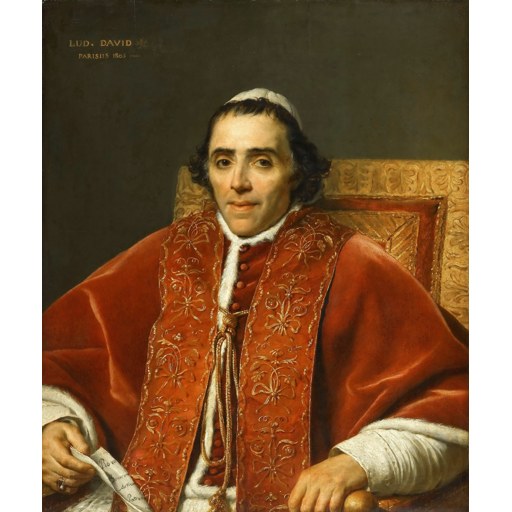
Jacques-Louis David
License: Public domain
Pius VII
Servant of God- Life Span
- 1742 - 1823 (age 81)
- Gender
- male
- Church
- Catholic
Places
Relics & Where to Venerate
Location unknown
The bodily remains of Pius VII are a first-class relic. Venerated at St. Peter's Basilica.
Roles & Family
Religious Information
Biography
Barnaba Niccolò Maria Luigi Chiaramonti, later Pope Pius VII, was born on 14 August 1742 in Cesena in the Papal States, the son of Count Scipione Chiaramonti and Giovanna Coronata Ghini, of the local nobility. In 1756 he entered the Benedictine abbey of Santa Maria del Monte near Cesena and took the religious name Gregorio. After further study, including at Padua, he taught theology in Benedictine houses. Pope Pius VI, to whom he was related by family connection, named him bishop of Tivoli in 1782 and in 1785 created him cardinal and transferred him to the diocese of Imola. As bishop of Imola during the French Revolutionary Wars he struck a comparatively moderate pastoral note; a Christmas homily of 1797 was later cited for the claim that democratic government was not in itself contrary to the Gospel.
After Pius VI died in French captivity, the conclave of 1799–1800 met in exile at San Giorgio Maggiore in Venice. Chiaramonti was elected pope on 14 March 1800 and took the name Pius VII. He returned to Rome later that year and made Ercole Consalvi secretary of state. The Concordat of 1801 restored a legal position for the Catholic Church in France, though Napoleon added the Organic Articles on his own authority. In 1804 the pope went to Paris for the imperial coronation, at which Napoleon crowned himself in the pope's presence. Relations then collapsed as French forces occupied Rome and annexed the Papal States. In 1809 Pius VII excommunicated those responsible for the seizure of papal territory; French troops arrested him at the Quirinal Palace in July 1809.
He was confined first at Savona and from 1812 at Fontainebleau. Isolated and under pressure, he signed in January 1813 a draft concordat favorable to Napoleon, which he retracted soon afterward. Released after Napoleon's military collapse, he re-entered Rome on 24 May 1814. At the Congress of Vienna, Consalvi obtained the restoration of most of the Papal States. On 7 August 1814 the bull Sollicitudo omnium ecclesiarum restored the Society of Jesus worldwide, reversing the suppression of 1773. The restored papal regime combined older structures with administrative reforms associated with Consalvi; it was neither a full return to the eighteenth-century order nor a liberal state.
In later years Pius VII continued papal patronage of the arts and of antiquarian work in Rome. He fell in July 1823, breaking his thigh, and died in Rome on 20 August 1823. He was buried in Saint Peter's Basilica, where a monument by Bertel Thorvaldsen later marked his tomb. His pontificate is remembered for the conflict with Napoleon, the restoration of the Jesuits, and the diplomatic recovery of the temporal power after 1814. A diocesan cause for beatification was opened in the early twenty-first century; he is titled Servant of God but has not been beatified or canonized.