Polychronius is a saint of the Catholic Church. Polychronius's feast day is celebrated on February 17.
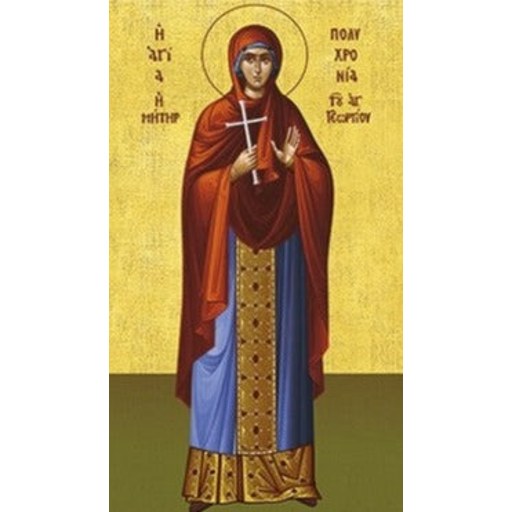
https://handmadeiconsgreece.myshopify.com/en-us/products/saint-polychronia-the-mother-of-saint-george
License: unknown
Polychronius
Saint- Feast Day
- February 17
- Gender
- male
- Church
- Catholic
Roles & Family
Biography
Polychronius is commemorated in the Roman Martyrology and in related Eastern synaxaria as a bishop of Babylon who suffered martyrdom during the persecution associated with the Roman emperor Decius in the mid-third century. Almost nothing can be established about his early life, family, education, or the circumstances of his elevation to the episcopate. The surviving notices depend on later martyrological compilations rather than on contemporary letters, inscriptions, or court records. Even the identification of his see is historically difficult: by the middle of the third century the ancient city of Babylon lay in Sasanian rather than Roman territory, whereas the Decian edicts against the Christians were measures of the Roman imperial government. For that reason some historians have treated the Babylonian setting as conventional or legendary, or have suggested that the name Babylon was used in a symbolic or loosely geographical sense rather than as a precise civic localization.
According to the traditional passion attached to his name, Polychronius was arrested together with the priests Parmenius, Helimenas (also given as Elymas or Elimenas), and Chrysotelus, and the deacons Luke and Mucius. Brought before the authorities, the bishop is said to have remained silent under interrogation. Later narrative layers describe him as being struck down at the altar while celebrating the Eucharist, a motif that recurs in several hieromartyr legends and that served to underline the sanctity of the liturgy and of the priestly office. His companions are reported to have undergone further tortures and executions, in versions that sometimes relocate parts of the story to Persia or to other cities of the East. As they now stand, these acts show signs of later literary development and cannot be read as a straightforward record of a single, recoverable judicial process.
Liturgical tradition assigned Polychronius a feast on 17 February in the Roman Martyrology, where he is listed at Babylon with his companions. Eastern calendars have also preserved his memory as a hieromartyr, occasionally on neighbouring dates, and the group has been held up as an example of episcopal and clerical steadfastness under persecution. No ancient local cult with a securely attested shrine, identifiable relics, or contemporary inscription has been demonstrated. He is not associated with a documented religious order in the later monastic sense, nor with a recorded marriage, children, or any historically verified patronage of places, trades, or causes. Subsequent hagiographical collections generally repeated the martyrology’s brief notice without adding independently verifiable biographical detail.
Because the sources are late, terse, and geographically hard to reconcile with the known politics of the Decian persecution, Polychronius remains an obscure figure: a name kept by the Church’s commemorative calendar rather than a career that can be reconstructed from reliable narrative history. What may be said with caution is that Christian memory in both East and West retained the figure of a bishop called Polychronius, linked with a small clerical group, as a witness from the age of the third-century persecutions, and that this memory was fixed in the standard Latin martyrology on 17 February. Other historical persons of the same name, including the fifth-century bishop of Apamea in Syria who commented on the Old Testament, are distinct from this martyrological tradition and should not be conflated with it.