Pope is a saint of the Catholic Church.
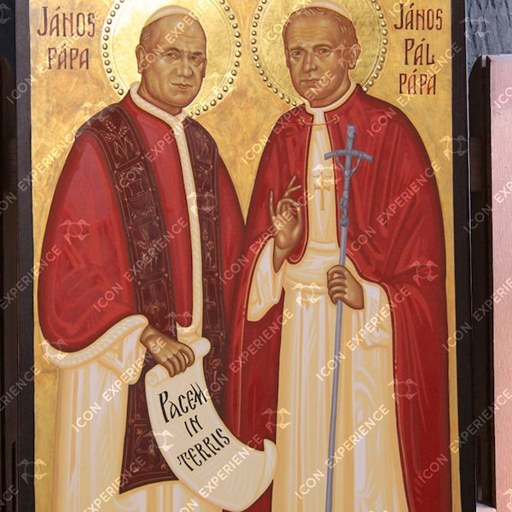
https://etsy.com/market/painting_of_pope
License: unknown
Pope
Saint- Church
- Catholic
Biography
The word Pope is a title, not the proper name of one historical person, so no verified birth year, death year, birthplace, burial site, or other personal vital statistics can be attached to a single individual from this heading alone. In the Catholic Church the title designates the Bishop of Rome, regarded in that tradition as successor of the apostle Peter and visible head of the Latin Church. The Greek pappas (father) was at first a respectful form of address for bishops in general; only over later centuries did it become, in the West, a distinctive style of the Roman pontiff. A separate but related use belongs to the Coptic Orthodox Church of Alexandria, whose patriarch is commonly called the Coptic Pope and whose succession is traced in that church to Saint Mark, independent of Rome.
Catholic tradition holds that Peter ministered and died in Rome in the first century and that the bishops who followed inherited a unique pastoral charge. The earliest Roman episcopal lists were compiled long after the events they describe and cannot be treated as contemporary civil registers; names, order, and dates for the first generations remain debated among historians. Over subsequent centuries the Roman see acquired wide spiritual authority in Western Europe and, after the decline of imperial administration in Italy, a substantial temporal role as well. Councils, papal decretals, and the growth of canon law defined teaching, jurisdiction, and the appointment of bishops. The method of choosing a pope also changed: from local clergy and people, through periods of imperial and aristocratic influence, to election by the college of cardinals in a closed conclave, the form still used in the Latin Church.
Because the office has been held by hundreds of men across two millennia, marital status, children, religious order, canonization, feast days, and patronages are properties of particular popes, not of the title. Some early bishops of Rome are reported in later sources to have been married before ordination; the Latin Church later required clerical celibacy. A few popes have been formally canonized or beatified; most have not. Patronages attached in popular devotion to Saint Peter or to named pontiffs (for example, a particular Pius or John) cannot be transferred to an unnamed occupant of the see.
Without a specific name, pontifical number, or other reliable identifier (such as a conventional designation like Gregory I or Shenouda III, or a corresponding catalogue entry), fields that demand a verified year of birth must remain empty. Substituting the year a man became bishop, was elected, or took a throne name would violate the distinction between office and biography. The papacy as an institution can be outlined in this way; the life of any one pope cannot be reconstructed from the word Pope alone.