Pope Alexander is a saint of the Catholic Church (d. 115). Pope Alexander's feast day is celebrated on 3 May.
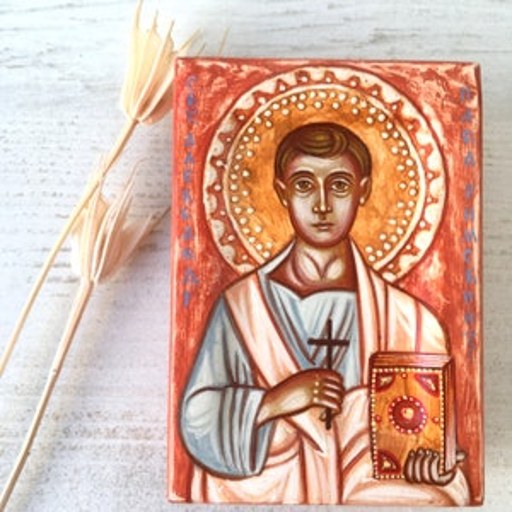
https://www.etsy.com/listing/1069217265/st-hieromartyr-alexander-i-pope
License: unknown
Pope Alexander
Saint- Life Span
- d. 115
- Feast Day
- 3 May
- Gender
- male
- Church
- Catholic
Places
Roles & Family
Canonization
Biography
Pope Alexander I was Bishop of Rome in the early second century, conventionally placed in the years around 105 to 115, spanning the later reign of Trajan and the beginning of Hadrian's. In the traditional succession he is counted as the sixth pope after Saint Peter. Almost nothing about him can be established from documents of his own time. The main narrative source is the later Liber Pontificalis, whose second-century entries mix liturgical memory with legend, together with the bare episcopal lists preserved by Eusebius of Caesarea, who names Alexander in the Roman succession but records no biography and does not call him a martyr.
According to the Liber Pontificalis he was a Roman by birth, the son of a man also named Alexander, from the district known as Caput Tauri. The same compilation attributes to him two liturgical measures: the insertion into the Mass of the institution narrative recalling Christ's actions at the Last Supper, and the blessing of houses with water mixed with salt. Historians treat both claims with caution; they more probably reflect later Roman custom read back onto an early pontiff. No reliable information survives about his family, formation, or activity before he became bishop, and there is no contemporary evidence that he belonged to a religious order or that he was married.
Later martyrological tradition made Alexander a martyr beheaded on the Via Nomentana together with the priests Eventius and Theodulus. A cemetery and, in time, a basilica of Sant'Alessandro on that road became the centre of his Roman cult. Critical hagiography regards the martyrdom as unproven: Eusebius is silent on any passion, and Alexander may have died a natural death. His name was entered in the Roman Martyrology on 3 May with Eventius and Theodulus. In the 1969 revision of the General Roman Calendar the feast was not retained among the universal celebrations, though he remains in the Martyrology.
Relics associated with Alexander and his companions were venerated at the Via Nomentana sanctuary. In the ninth century some relics were translated to Freising in Bavaria, which helped to spread the cult in the German-speaking lands. Beyond the succession lists, the later liturgical attributions, and the martyr legend, the historical Alexander remains an obscure figure of the post-apostolic Roman church, important chiefly as a link in the episcopal line between the generation of Clement and the more clearly attested pontificate of Pius I.