Pope Anastasius is a saint of the Catholic Church (d. 401). Pope Anastasius's feast day is celebrated on 19 December.
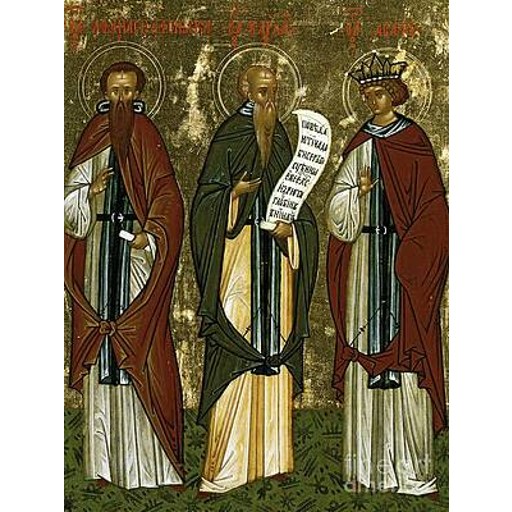
https://fineartamerica.com/art/paintings/athanasius
License: unknown
Pope Anastasius
Saint- Life Span
- d. 401
- Feast Day
- 19 December
- Gender
- male
- Church
- Catholic
Places
Roles & Family
Biography
Pope Anastasius I was Bishop of Rome at the close of the fourth century and the opening of the fifth, a short pontificate whose historical profile rests on a handful of contemporary notices and on the later Roman Liber Pontificalis. That source describes him as a Roman by birth, the son of a man named Maximus; no independent evidence supplies a year of birth, and none should be inferred from the date of his accession. He succeeded Pope Siricius and was consecrated in late 399, most often dated 27 November. He died in Rome on 19 December 401 and was buried in the cemetery of Pontianus on the Via Portuensis. He is the earliest of several popes to bear the name Anastasius and the one whom the Latin church has venerated as a saint.
The act for which his reign is best documented is his condemnation of the writings of Origen of Alexandria. Reports reached Rome from Theophilus of Alexandria and from Western theologians alarmed by the circulation of Origenist doctrine. Anastasius judged that Origen’s books contained grave errors and were not to be read, and he required that persons associated with those views retract them before being received into communion. He wrote on the subject to Simplicianus of Milan and, after Simplicianus’s death, to Venerius. Saint Jerome, then at Bethlehem and himself a principal figure in the Origenist disputes, praised Anastasius as a man of holy life and apostolic zeal. Surviving correspondence also places Anastasius in contact with Augustine of Hippo and Paulinus of Nola, so that his brief tenure belongs to the same Latin episcopal network that dominated Western theology in that generation.
Later Roman tradition ascribes to him a liturgical direction that priests should stand and bow their heads during the reading of the Gospel, a detail consistent with the growing ceremonial formality of Roman public worship. The Liber Pontificalis further credits him with building a basilica called Crescentiana in the second region of Rome, though the church has not been identified with certainty. Politically he governed while Honorius was emperor in the West and while Gothic pressure on Italy was increasing, but the extant record of his acts is almost entirely ecclesiastical. He was succeeded by Innocent I. The Liber Pontificalis calls Innocent his son; modern historians treat that claim with caution, as it may be legendary, a later interpolation, or a spiritual rather than biological designation, and it is not secure evidence that Anastasius had been married or had children.
Because he lived centuries before the medieval and modern processes of papal canonization, no individual pontiff is recorded as having canonized or beatified him. His cult rests on ancient Roman veneration and on his entry in the Roman Martyrology, which keeps his feast on 19 December. No well-attested patronages of places, professions, or causes are attached to his name in the standard hagiographical collections. His historical importance is that of a brief but firm Roman intervention in the Origenist crisis and of a pope whom the leading Latin Fathers of his own day regarded as orthodox and austere.