Pope Fabian is a saint of the Catholic Church (d. 250). Pope Fabian's feast day is celebrated on 20 January.
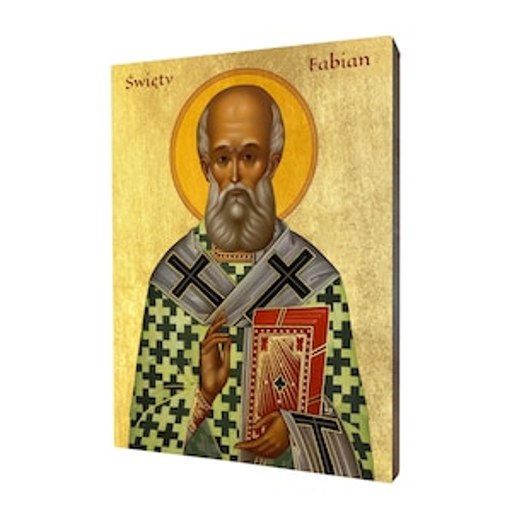
https://etsy.com/market/saint_fabian
License: unknown
Pope Fabian
Saint- Life Span
- d. 250
- Feast Day
- 20 January
- Gender
- male
- Church
- Catholic
Places
Roles & Family
Biography
Fabian (Latin: Fabianus) was Bishop of Rome from 236 until his death in 250. Almost nothing can be verified about his birth, family, or early life. The principal ancient account of his election is given by Eusebius of Caesarea in the early fourth century. After the death of Pope Anterus, the Roman church gathered to choose a successor. Fabian, described as a layman who had come in from the country rather than as a member of the city’s clerical elite, was present in the assembly. Eusebius reports that a dove descended and settled on his head, which those present interpreted as a sign of the Holy Spirit analogous to the baptism of Christ. Though he had not been among the leading candidates, clergy and people acclaimed him bishop. The story is hagiographic in coloring, but it is the earliest narrative we possess and is generally taken to reflect a genuine tradition that his election was unexpected.
His episcopate of about fourteen years fell in a comparatively quiet interval for the Roman church, between earlier local troubles and the empire-wide persecution under Decius. Eusebius records that Fabian recovered the body of Pope Pontian, who had died in exile in the mines of Sardinia, and gave him burial in Rome. Later tradition, preserved in the Liber Pontificalis, ascribes to Fabian a reorganization of the Roman community into seven districts under deacons and the appointment of subdeacons to collect the acts of the martyrs. The Liber Pontificalis is often unreliable for the third century, so those specific administrative details cannot be treated as certain; some consolidation of the Roman church’s structure in this period is nonetheless plausible. Fabian is also known to have corresponded with Origen and to have ordained bishops for other sees, exercising a recognized authority beyond the city itself. Legendary claims that he sent missionary bishops to Gaul rest on late and doubtful sources and should not be presented as established fact.
Peace ended with the accession of the emperor Decius in 249. In early 250 Decius issued an edict requiring inhabitants of the empire to sacrifice to the traditional gods and to obtain a certificate of compliance. Refusal was treated as a political crime. Fabian was arrested at the outset of this first systematic, empire-wide persecution of Christians and died a martyr on 20 January 250, either in prison or by execution. Cyprian of Carthage, writing as a contemporary, praised him as incomparable in the holiness of his life and in the glory of his witness. The intensity of the persecution left the Roman see vacant for more than a year, until the election of Cornelius in 251.
Fabian was buried in the papal crypt of the Catacomb of Callixtus on the Appian Way. A fragmentary Greek epitaph found there in the nineteenth century, reading in substance “Fabianos, bishop, martyr,” confirms the ancient identification of the tomb. His deposition on 20 January in the cemetery of Callistus is already listed in the Depositio Martyrum of the Chronography of 354. He has been venerated as a saint and martyr from the third century; no later papal canonization was involved. In the Roman calendar his feast is kept on 20 January, often associated with that of Saint Sebastian. The recoverable evidence for his life is limited to Eusebius, Cyprian, the early Roman martyrological lists, the catacomb inscription, and later compilations that must be used with caution.