Pope Gelasius is a saint of the Catholic Church (d. 496). Pope Gelasius's feast day is celebrated on 21 November.
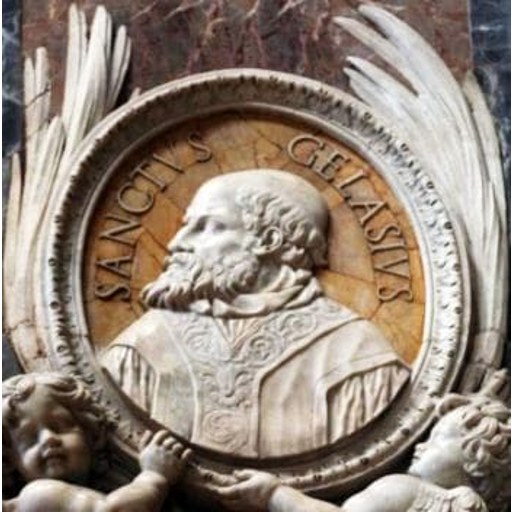
https://saintforaminute.com/saints/pope_saint_gelasius_i
License: unknown
Pope Gelasius
Saint- Life Span
- d. 496
- Feast Day
- 21 November
- Gender
- male
- Church
- Catholic
Places
Roles & Family
Biography
Pope Gelasius I was Bishop of Rome from March 492 until his death in November 496, a short pontificate that left an unusually large written record for the fifth century. The Liber Pontificalis describes him as of African origin (natione Afer), the son of a man named Valerius; later writers often present him as Roman-born of African extraction. No reliable source preserves the year or precise place of his birth. Before his election he served as a deacon of the Roman church and appears to have drafted much of the correspondence of his predecessor, Pope Felix III, especially in the dispute with Constantinople. He was consecrated in 492, as Italy passed from Odoacer to the Ostrogothic king Theodoric, while the imperial court at Constantinople still claimed a distant suzerainty over the West.
The central public conflict of his reign was the Acacian schism, which had begun in 484 over Emperor Zeno’s Henotikon and Patriarch Acacius of Constantinople. Gelasius refused any restoration of communion that would leave Acacius or his successors in the diptychs without recantation and without acceptance of Roman judgments on the matter. He wrote to Emperor Anastasius I and to Eastern bishops in terms that asserted the Petrine authority of the Roman see and denied that an emperor could settle doctrine by edict. In a letter of 494 to Anastasius, known from its opening words Duo sunt, he distinguished the two powers by which the world is chiefly ruled, the sacred authority of priests and the royal power, and argued that the priestly power is the weightier because priests must answer before God for kings themselves. That letter became a standard medieval citation on the relation of sacerdotium and regnum. He also upheld the Council of Chalcedon against Eutychian and Henotic formulas and composed treatises on the two natures in Christ.
In Rome and Italy he acted as a disciplinary reformer and as a pastor in time of want. He is associated with measures against Manichaeans still found in the city, including the requirement that the faithful communicate under both kinds, a test aimed at those who refused the cup. A letter in his name to the senator Andromachus attacks the survival of the Lupercalia and argues that a Christian people cannot retain that pagan rite; whether the festival was actually suppressed at his order remains debated. The Liber Pontificalis stresses his almsgiving to the poor, the clergy, and churches during famine. Many surviving letters concern suburban and Italian sees, the validity of ordinations, and the reception of clergy who had lapsed in schism. He insisted that the Roman bishop is judged by no one and that metropolitan rights in the West could not override communion with Peter’s see.
A substantial body of letters and several tractates survive, making him one of the best-documented popes of late antiquity. The so-called Gelasian Sacramentary and the Decretum Gelasianum on canonical and apocryphal books were later attached to his name; modern scholarship treats both as later Roman compilations that used older materials rather than as documents he issued in their present form. Gelasius died in Rome on 19 November 496 and was buried in the basilica of St. Peter. He was succeeded by Anastasius II. His cult is ancient; the Roman Martyrology commemorates him on 21 November. Later canonists repeatedly cited his letters, above all Duo sunt. He is counted among the popes of African origin, together with Victor I and Miltiades, and is venerated as a saint in the Catholic Church.