Pope Gregory VII is a saint of the Catholic Church (d. 1085). Pope Gregory VII's feast day is celebrated on 25 May.
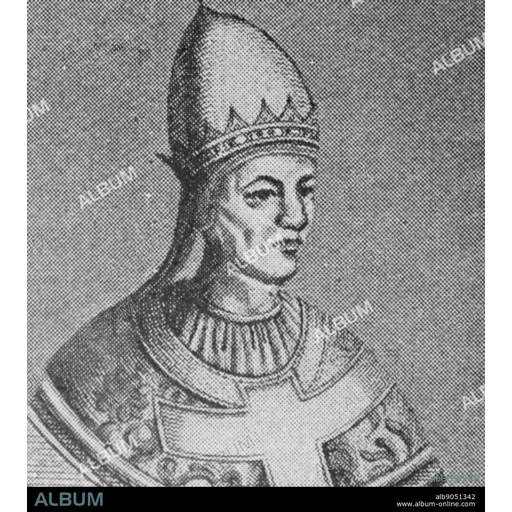
https://www.album-online.com/detail/en/Y2ExMjNmMA/portrait-pope-gregory-vii-1020-1085-saint-born-hildebrand-sovana-alb9051342
License: unknown
Pope Gregory VII
Saint- Life Span
- d. 1085
- Feast Day
- 25 May
- Gender
- male
- Church
- Catholic
Places
Roles & Family
Religious Information
Canonization
Biography
Pope Gregory VII, known before his election as Hildebrand of Sovana (Ildebrando di Soana), was born in the town of Sovana in Tuscany in the early eleventh century. Contemporary sources do not record an exact year of birth; later historians have proposed dates ranging from about 1015 to about 1025. His family background is likewise uncertain: some medieval and early modern writers attributed to him descent from the Aldobrandeschi, while others described his origins as modest. He was sent to Rome for education, probably at the Lateran or at the monastery of Santa Maria on the Aventine, and entered clerical and monastic life. He is associated with the Benedictine tradition and spent time at the abbey of Cluny, whose reforming ideals of ecclesiastical independence and moral discipline left a lasting mark on him.
Hildebrand became one of the principal architects of the eleventh-century papal reform. He served under Pope Leo IX and subsequent reforming pontiffs as a legate, administrator, and, from the late 1050s, as archdeacon of the Roman Church, a position that made him the leading figure in the papal government. He was instrumental in the election of Pope Nicholas II and in the 1059 decree that assigned the choice of the pope primarily to the cardinal-bishops, thereby reducing the influence of the Roman nobility and the German court. After the death of Alexander II in April 1073, the clergy and people of Rome acclaimed Hildebrand as pope. He was consecrated on 29 June 1073 and took the name Gregory VII. From the outset he pursued a program later known as the Gregorian Reform: the suppression of simony, the enforcement of clerical celibacy, and the liberation of the Church from lay investiture and secular control.
These policies brought Gregory into prolonged conflict with Henry IV, king of Germany and later Holy Roman Emperor, in the struggle known as the Investiture Controversy. In 1075 a collection of propositions associated with Gregory, often called the Dictatus Papae, asserted that the Roman pontiff alone possessed universal jurisdiction, that he might depose emperors, and that he was subject to no earthly judgment. When Henry persisted in appointing bishops and supporting clergy whom the pope regarded as simoniacal, Gregory excommunicated him in 1076 and declared him deposed. Confronted by a revolt of the German princes, Henry crossed the Alps in winter and appeared as a penitent at the castle of Canossa in January 1077, where Gregory was the guest of Countess Matilda of Tuscany. After three days of public penance the pope granted absolution. The settlement did not last. Renewed civil war in Germany, a second excommunication of Henry, and the king’s expedition to Italy followed. In 1084 Henry occupied Rome, installed the antipope Clement III (Wibert of Ravenna), and received imperial coronation. Gregory took refuge in the Castel Sant’Angelo until the Norman duke Robert Guiscard marched on the city, forcing Henry to withdraw. The subsequent Norman sack of Rome alienated the Roman population from the pope.
Gregory withdrew with the Normans to southern Italy and spent his final months in Salerno. He died there on 25 May 1085. A well-attested tradition records his last words as “I have loved justice and hated iniquity; therefore I die in exile.” He was buried in the cathedral of Salerno, where his tomb is still venerated. Gregory VII was beatified by Pope Gregory XIII in 1584 and canonized by Pope Benedict XIII in 1728. The Latin Church observes his feast on 25 May. His pontificate is widely regarded as a turning point in the history of the medieval papacy, establishing claims of papal supremacy that would shape the high Middle Ages and the long contest between spiritual and temporal authority in Western Europe.