Pope Nicholas is a saint of the Catholic Church (d. 867). Pope Nicholas's feast day is celebrated on 13 November.
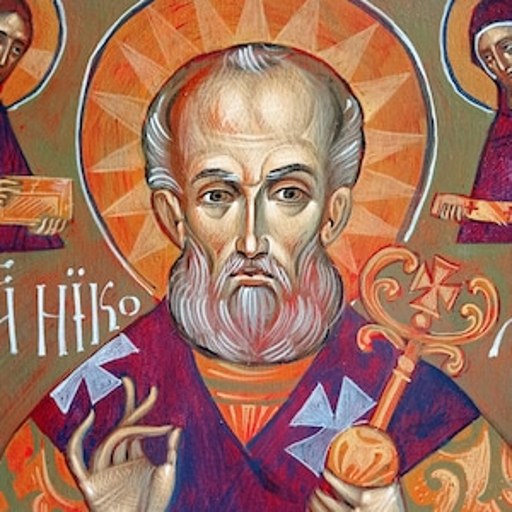
https://www.etsy.com/fi-en/listing/4396836182/saint-nicholas-icon-painting-copy
License: unknown
Pope Nicholas
Saint- Life Span
- d. 867
- Feast Day
- 13 November
- Gender
- male
- Church
- Catholic
Places
Roles & Family
Biography
Pope Nicholas I, commonly known as Nicholas the Great, was Bishop of Rome from 858 until his death in 867 and is the only pope of that name venerated as a saint in the Catholic Church. He was born in Rome, the son of a man named Theodore who belonged to the city’s administrative elite; a precise year of birth is not securely attested. Formed among the Lateran clergy, he was ordained subdeacon by Pope Sergius II and deacon by Pope Leo IV, and he served as a principal counsellor to Pope Benedict III. He was a secular Roman cleric, not a member of a religious order. Elected on 24 April 858 and consecrated in the presence of the emperor Louis II, he treated the Roman see from the outset as the supreme appellate court of the Latin Church and as the guardian of canonical discipline against both metropolitans and kings.
In Italy he compelled John, archbishop of Ravenna, to answer at Rome and to restore rights Nicholas judged to have been usurped. In the Frankish kingdoms he supported Bishop Rothad of Soissons against deposition by Hincmar of Reims, insisting that the more serious causes of bishops belonged to papal judgment. The Western conflict that most clearly displayed his view of authority was the attempt of King Lothair II of Lotharingia to set aside Queen Theutberga and to have his union with Waldrada recognized. Frankish synods, backed by Archbishops Gunther of Cologne and Theutgaud of Trier, favoured the king. Nicholas annulled those acts, deposed the two archbishops, and maintained that a valid Christian marriage could not be dissolved for a ruler’s convenience. The case became a precedent for later medieval claims that Rome judged royal marriages.
The other great theatre of his reign was the East. After Patriarch Ignatius of Constantinople was expelled and the scholar Photius was installed, Nicholas, responding to Ignatius’s appeal, refused recognition to Photius and in 863 declared him deposed, asserting Rome’s right to hear such causes. Papal legates in Constantinople failed to settle the matter on Nicholas’s terms, and relations deteriorated. When Boris, khan of the Bulgars, accepted baptism and sought a church order for his people, Rome and Constantinople competed for jurisdiction. In 866 Nicholas sent the Responsa ad consulta Bulgarorum, a long set of answers on liturgy, law, and pastoral practice, hoping to place the Bulgarian church under Roman rather than Byzantine authority. The dual struggle over Photius and over Bulgaria did not produce an immediate permanent schism, but it defined the ninth-century clash between papal and patriarchal claims.
Nicholas died in Rome on 13 November 867 and was buried at Saint Peter’s. Adrian II succeeded him. Latin tradition later ranked Nicholas with Leo I and Gregory I among popes styled the Great, a title that records his unyielding doctrine of Roman primacy, his extensive correspondence, and his readiness to depose metropolitans and to defy royal pressure. He is commemorated as a saint on 13 November. No well-documented list of particular patronages comparable to those of Nicholas of Myra is attached to him, and the early medieval process by which he entered the martyrology is not equivalent to a modern canonization with a named pope as canonizer.