Prophet Samuel is a saint of the Catholic Church. Prophet Samuel's feast day is celebrated on 20 August.
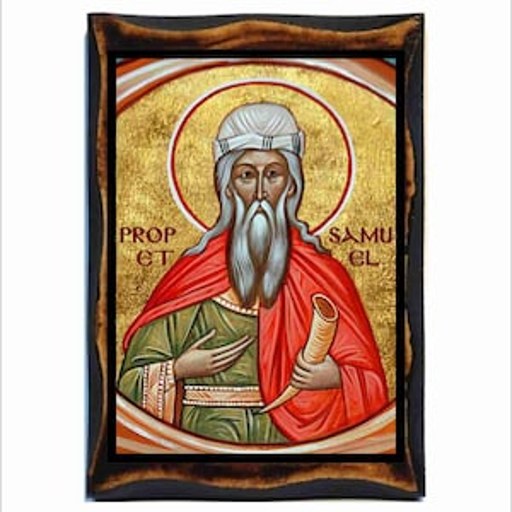
https://www.etsy.com/market/saint_samuel_icon
License: unknown
Prophet Samuel
Saint- Feast Day
- 20 August
- Gender
- male
- Church
- Catholic
Places
Roles & Family
Biography
Samuel is the prophet, seer, and judge who stands at the center of the biblical Books of Samuel, marking the transition in ancient Israel from the era of the judges to the monarchy. According to 1 Samuel, he was the son of Elkanah of Ramathaim-zophim in the hill country of Ephraim and of Hannah, who had been childless. Hannah prayed at the sanctuary of Shiloh and vowed that if she bore a son she would dedicate him to the Lord’s service; after Samuel’s birth she brought him as a young child to serve under the priest Eli. The narrative of his call as a boy—when the Lord spoke to him concerning judgment on Eli’s house because of the corruption of Eli’s sons Hophni and Phinehas—establishes him as a prophet whose word was recognized throughout Israel. Precise years of birth and death cannot be verified from independent historical sources; the events associated with him are conventionally placed by historians in the eleventh century BCE, in the closing phase of the period of the judges.
After the Philistine capture and return of the Ark of the Covenant and a time of national distress, Samuel summoned Israel to repentance at Mizpah. The biblical account credits the Lord with a subsequent victory over the Philistines. Samuel then exercised the office of judge, making a regular circuit among Bethel, Gilgal, and Mizpah and returning to Ramah, where he maintained his home and built an altar. In his old age the elders of Israel demanded a king so that they might be like other nations. Though the request displeased him, Samuel, at the Lord’s command, anointed Saul of the tribe of Benjamin as Israel’s first king. When Saul later disobeyed divine instructions, Samuel announced that the kingdom would be torn from him and, in a private anointing at Bethlehem, designated David son of Jesse as future king. Relations between Samuel and Saul thereafter collapsed; Samuel withdrew to Ramah and is not depicted as returning to Saul’s court.
The biblical text records that Samuel died and that all Israel assembled to mourn him; he was buried in his house at Ramah. He is stated to have had two sons, Joel and Abijah, whom he appointed as judges in Beersheba; they are described as corrupt, taking bribes and perverting justice, which the narrative presents as one of the reasons the people pressed for a king. His wife’s name is not given. A later episode in 1 Samuel describes Saul, on the eve of battle, consulting a medium at Endor who is said to have summoned Samuel’s spirit. Jewish, Christian, and Islamic traditions all regard Samuel as a prophet. In Christianity he is venerated as a saint, with a feast on 20 August in the Roman Martyrology and in the calendars of the Eastern Orthodox Church. He was never Bishop of Rome or Coptic Pope, nor did he hold the later ecclesiastical office of patriarch or catholicos. No reliable extra-biblical evidence independently confirms the details of his biography; the portrait that survives is that of the biblical and subsequent religious tradition.