Q4268670 is a saint of the Catholic Church (1349 - 1444). Q4268670's feast day is celebrated on 25 January.
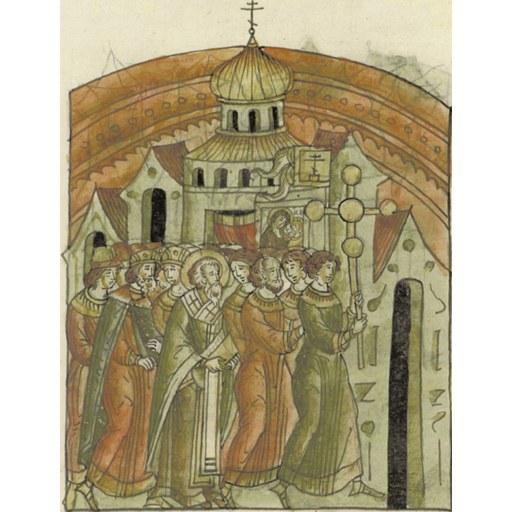
Anonymous Russian manuscript illuminators, 1560-1570s Facial Chronicle (Illustrated Chronicle of Ivan the Terrible) (in 10 volumes: pdf, pdf with translation)Public domain image
License: Public domain
Q4268670
Saint- Life Span
- 1349 - 1444 (age 95)
- Feast Day
- 25 January
- Gender
- male
- Church
- Catholic
Places
Roles & Family
Biography
Saint Macarius of Unzha, also called Macarius of Yellow Waters or Macarius the Wonderworker, was a Russian Orthodox monk, abbot, and monastic founder of the fourteenth and fifteenth centuries. Traditional hagiographical accounts place his birth in 1349 in Nizhny Novgorod, then the center of its own principality, in a family remembered for Christian piety. From childhood he showed a marked inclination to prayer and asceticism. At the age of twelve he entered the Pechersky (Caves) Monastery in his native city, received the monastic tonsure, and spent his early years in obedience, fasting, and spiritual labor under the monastery’s elders.
Seeking greater solitude, Macarius later left Nizhny Novgorod and settled in a remote wooded area near the Volga at a site known as Yellow Lake or Yellow Waters. Disciples gathered around him, and the hermitage grew into the Zheltovodsky Trinity Monastery. In the late 1430s the community was destroyed during a Tatar raid linked to Khan Ulu-Muhammad. Macarius and many of the brethren were taken captive. According to his life, the khan, impressed by the monk’s meekness and by reports of miracles, released the prisoners on condition that the monastery not be rebuilt at that location.
Macarius then traveled north with remaining disciples to the Unzha River in the Kostroma lands and founded a new community dedicated to the Holy Trinity, later known as the Unzhensky or Makaryev-Unzhensky Monastery. He served as its abbot, continuing a life of strict asceticism, pastoral care, and reported gifts of healing and clairvoyance. He died on 25 January 1444 at an advanced age traditionally given as ninety-five and was buried at the monastery he had established on the Unzha.
Local veneration began soon after his death. His relics were later reported incorrupt, and he came to be glorified as a saint in the Russian Orthodox Church. He is commemorated on 25 January, the day of his repose. The two monasteries associated with him became lasting centers of pilgrimage. Historical knowledge of Macarius rests primarily on later vitae that combine datable events of the Tatar period with the miracle accounts typical of the genre; he remains an important figure in the monastic revival of northeastern Rus’ after the Mongol era.