Q4296354 is a saint of the Eastern Orthodox Church (d. 992). Q4296354's feast day is celebrated on 15 June and 30 September.
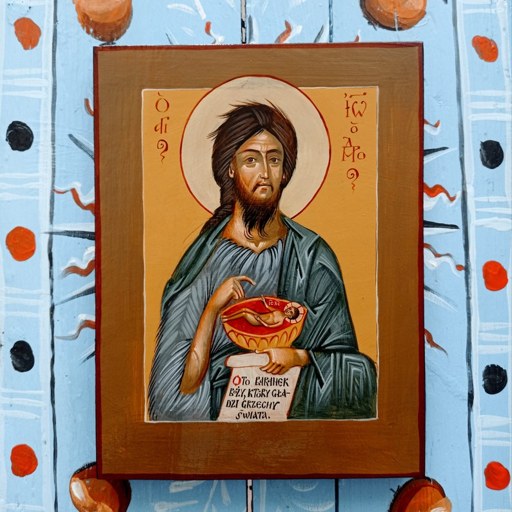
https://www.etsy.com/uk/listing/1518487637/saint-john-the-baptist-picture-icon
License: unknown
Q4296354
Saint- Life Span
- d. 992
- Feast Day
- 15 June and 30 September
- Gender
- male
- Church
- Eastern Orthodox
Places
Roles & Family
Biography
The figure known as Saint Michael of Kiev occupies a foundational yet historically elusive place in the early history of Christianity among the Eastern Slavs. Church tradition, drawing primarily from later Rus' chronicles such as the Nikon Chronicle and hagiographical texts, identifies him as the first Metropolitan of Kiev, dispatched from Constantinople in the wake of Prince Vladimir Sviatoslavich's baptism and the official conversion of Kievan Rus' in 988. Accounts of his origins differ: some describe him as a native of Syria who had served in the Byzantine capital, while others link him to the Bulgarian church, which had already developed a Slavonic liturgy. Because no contemporary Byzantine source names a metropolitan Michael at this date, and because some chronicles anachronistically attribute his appointment to Patriarch Photius (who died in 886), a number of historians regard the traditional first metropolitan as a legendary or composite figure. The earliest metropolitan whose existence is confirmed by both Greek and Rus' documents is Theopemptos, active in the 1030s.
According to the received narrative, Michael arrived in Kiev with a group of clergy, liturgical books, and sacred vessels. He is said to have participated in or immediately followed the mass baptism of the Kievans in the Dnieper, to have instructed Vladimir and the boyars in the faith, and to have begun the organization of a diocesan structure. Tradition credits him with the consecration of the first bishops for Novgorod and other centers, the suppression of pagan cult sites, and the initiation of church building, including the wooden predecessor of the Church of the Tithes. His short episcopate coincided with the earliest phase of Christianization, a period marked by both enthusiastic princely support and residual pagan resistance in the countryside.
Michael died in Kiev on 15 June 992 and was buried in the Church of the Tithes, the masonry cathedral whose construction Vladimir had undertaken as a thanksgiving for his conversion and military successes. Subsequent tradition reports that his relics were found incorrupt. They were later translated, and he came to be venerated at the Kyiv Pechersk Lavra. The Orthodox Church commemorates him on 15 June, the anniversary of his repose, and on 30 September, the day associated with the translation of his relics. He is depicted in iconography as a bishop wearing the omophorion, often holding a Gospel book, and sometimes shown together with Saint Vladimir.
Although modern scholarship treats the tenth-century metropolitanate with caution owing to the paucity of sources, Saint Michael remains an important symbol of the apostolic foundation of the Church in Rus' for Orthodox believers in Ukraine, Russia, Belarus, and the diaspora. His cult is local rather than universal, and he is not associated with a wide array of specific patronages in the manner of later, more popularly invoked saints. No records indicate that he was married or had children; as a bishop of the Eastern Church he would have been drawn from the monastic clergy and lived in celibacy.