Q4302733 is a saint of the Eastern Orthodox Church (d. 1043). Q4302733's feast day is celebrated on 26 July.
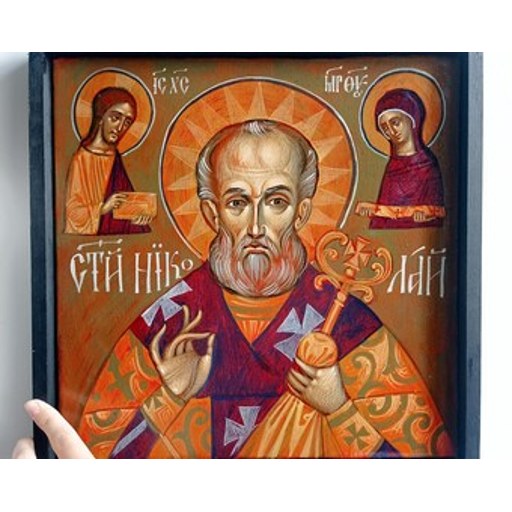
https://www.etsy.com/listing/1223369423/christ-pantocrator-icon-portrait-image
License: unknown
Q4302733
Saint- Life Span
- d. 1043
- Feast Day
- 26 July
- Gender
- male
- Church
- Eastern Orthodox
Places
Roles & Family
Biography
Moses the Hungarian (Church Slavonic: Moisei Ugrin) was an eleventh-century monk of the Kiev Pechersk Lavra whose memory is preserved in the Kievan Caves Paterikon. He was of Magyar origin and belonged, with his brothers George and Ephraim, to the Hungarian contingent in the service of the Riurikid princes. George was killed in 1015 together with Prince Boris Vladimirovich; Ephraim later founded a monastery at Torzhok and is himself venerated as a saint. Moses was in Kiev during the succession struggle that followed the death of Vladimir Sviatoslavich.
According to the Paterikon, Moses was among the captives taken when Bolesław I of Poland occupied Kiev in 1018 and was carried into Poland. A wealthy widow purchased him with the intention of making him her husband. He refused her offers of marriage, rank, and liberty, stating that he wished to keep chastity and to receive the monastic tonsure. The woman had him imprisoned, starved, and beaten; the hagiographical account further states that she ordered him castrated. After Bolesław’s death in 1025 and the ensuing unrest in Poland, the widow was killed and Moses obtained his freedom. A hieromonk tonsured him before he left Polish territory.
Moses then travelled to the cave community recently established by Anthony of Kiev on the Dnieper. He spent the rest of his life in the Caves Monastery and was remembered there as an ascetic who counselled monks struggling against sexual temptation. The Paterikon presents him as a particular intercessor for those battling unchastity. Traditional monastic chronology places his death in 1043. He was buried in the Near Caves (Anthony’s Caves), where his relics continued to be venerated.
He is commemorated in the Eastern Orthodox Church on 26 July and again on 28 September with the Synaxis of the Venerable Fathers of the Kiev Near Caves. His cult belongs to the earliest layer of Kievan monastic hagiography. The principal narrative source is the thirteenth-century Paterikon, which draws on earlier lavra tradition; no independent contemporary chronicle confirms the details of his captivity or mutilation, and those episodes rest on the hagiographical record.