Quadratus of Athens is a saint of the Pre-Schism (Universal) Church. Quadratus of Athens's feast day is celebrated on 26 May.
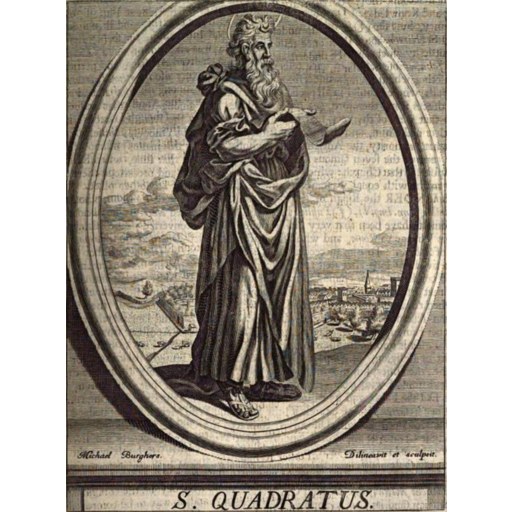
Michael Burghers
License: Public domain
Quadratus of Athens
Saint- Feast Day
- 26 May
- Gender
- male
- Church
- Pre-Schism (Universal)
Places
Roles & Family
Biography
Quadratus of Athens, known in Greek as Kodratos, was a Christian writer and churchman of the early second century, remembered as one of the earliest apologists for the Christian faith and, in ancient ecclesiastical tradition, as a bishop of Athens. Nearly all historically usable information about him comes from Eusebius of Caesarea in the Ecclesiastical History and from Jerome in On Illustrious Men, with later martyrologies adding liturgical commemorations. Eusebius quotes a fragment of an apology said to have been given to the emperor Hadrian and, citing Dionysius of Corinth, reports that a Quadratus became bishop of Athens after the martyrdom of Publius and gathered the community again after persecution. Ancient writers treated the apologist and the bishop as the same person, though a few modern scholars have allowed that two homonymous figures might have been combined.
The apology itself does not survive except for the passage Eusebius copied. In that excerpt Quadratus argues that the works of the Saviour were genuine and still verifiable, because people whom Jesus had healed or raised from the dead had remained alive not only during Christ's ministry but long after his death, so that some of them lived even into Quadratus's own time. The fragment was prized as a sign of early date and of what Eusebius called apostolic orthodoxy. The address to Hadrian is usually linked to the emperor's presence in Athens in the mid-120s. Jerome repeats that Quadratus was a disciple of the apostles, that he succeeded the martyred Publius, and that he presented a treatise in defence of Christianity when Hadrian was in Athens and visited Eleusis, calling Quadratus a man of outstanding talent and apostolic faith.
The episcopal notice depends on Dionysius of Corinth as reported by Eusebius: after Publius of Athens suffered martyrdom, Quadratus was appointed bishop and by his zeal restored the flock that persecution had scattered. No contemporary record gives Quadratus's birthplace, family, or the precise circumstances of his death. Later lists and the Apostolic Constitutions mention a Quadratus in connection with Magnesia, which has produced confusion with other early Christians of the same name, including a prophet Quadratus mentioned in Asian contexts. Eastern hagiography sometimes identified the Athenian bishop with Quadratus numbered among the Seventy Apostles; that identification is traditional rather than demonstrable from second-century evidence.
Quadratus is venerated as a saint in the Roman Catholic Church and the Eastern Orthodox Church. The Roman Martyrology commemorates him on 26 May at Athens, as a disciple of the apostles who collected the churches dispersed by persecution and who offered Hadrian a defence of the Christian religion. Orthodox usage likewise keeps 26 May for Quadratus of Athens, often as a hieromartyr, while an apostle Quadratus is separately commemorated on 21 September. A death date around 129 appears in many later calendars and reference works but is not stated by Eusebius or Jerome. He did not hold the papacy or a patriarchal see. Nothing reliable is recorded of a spouse, children, burial place, or membership in a later religious order.
Although only a few lines of his writing remain, Quadratus occupies a place at the head of the second-century apologetic tradition, shortly before or alongside Aristides of Athens and a generation before Justin Martyr. The surviving fragment is one of the earliest Christian attempts to defend the faith before a Roman emperor by appealing to public, still-living witnesses of Jesus' works. Beyond that text and the brief Athenian episcopal notice, the life of Quadratus is obscure, and later legend should be kept distinct from the limited testimony of Eusebius and Jerome.