Quirinus is a saint of the Catholic Church.
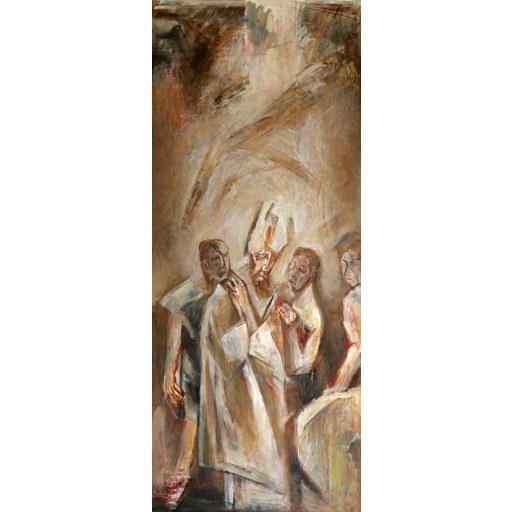
https://www.dreamstime.com/photos-images/saint-quirinus.html
License: unknown
Quirinus
Saint- Gender
- male
- Church
- Catholic
Roles & Family
Biography
The Latin name Quirinus belonged in pagan antiquity to a major god of the Roman state, associated with the Sabine component of early Rome and, in some literary traditions, with the deified Romulus. In Christian hagiography the same name was borne by several martyrs of the first four centuries whose identities later writers have not always kept distinct. Because the subject here is given only as Quirinus, without a diocese, a city of martyrdom, or a feast date, the only historically responsible course is to describe the principal cults rather than to invent a single composite life. None of these men was pope or patriarch of an Eastern see. For none of them is a year of birth, a native city, or a family history attested by a source independent of later legend, and later popular notices that supply such details generally rest on romance or on confusion among homonyms.
The martyr whose career can be placed with the least uncertainty is Quirinus, bishop of Siscia (today Sisak in Croatia) in the province of Pannonia. Siscia was a Roman colony and mint on the river Sava. In the final phase of the Great Persecution, customarily dated to 309, the bishop was arrested in his see and examined by Amantius, the provincial governor. The Latin Passio Sancti Quirini, a passion narrative that scholars generally regard as relatively early and comparatively restrained among Illyrian martyr acts, records that he refused to sacrifice, was beaten and imprisoned, and was then taken toward Savaria (modern Szombathely in Hungary). There, or on a river identified in the texts as the Sibaris, a millstone was fastened to his neck and he was thrown into the water and drowned. Christians recovered the body and buried it. The Hieronymian Martyrology and, later, the Roman Martyrology commemorate him on 4 June. He is honoured as patron of Sisak. No reliable evidence survives concerning his birth, education, or any spouse or children, nor is he known to have belonged to a later canonical religious order.
A second, largely legendary figure is the Roman martyr known in the Rhineland as Quirinus of Neuss. Medieval and early modern legend made him a tribune of the city of Rome who converted to Christianity, in some versions after contact with Pope Alexander I, and who was executed in the earlier second century, with years such as 116 or 117 often repeated in later calendars. Those dates, and the story that he was the father of Saint Balbina, belong to hagiographical romance; they are not confirmed by contemporary Roman evidence. Relics attributed to this Quirinus were translated in the eleventh century, according to the tradition of the church of Neuss, to that city on the Rhine, where the collegiate church later called the Quirinus-Münster became the centre of a vigorous cult. He was invoked against plague and many illnesses and was adopted as patron of Neuss. His Roman feast has been given as 30 March or 30 April in different books. Burial is variously associated with the catacomb of Praetextatus on the Via Appia and, after the translation, with Neuss.
A third cult, at the Benedictine abbey of Tegernsee in Bavaria, claimed relics of a Saint Quirinus brought from Rome in the eighth century. Whether that martyr is identical with the Roman tribune, with another of the several Quirini listed in the martyrologies, or with a local or confused tradition cannot be demonstrated. Other brief notices of a Quirinus appear in martyrologies at scattered places and dates. In all these cases canonization in the later papal sense did not occur; they are ancient martyrs received by the Church through cult and martyrology. Given the plurality of homonyms and the legendary character of much of the material, fields that would require choosing one man, one year of birth or death, one burial place, or one exclusive list of patronages are here left blank rather than filled by conjecture.