Quiteria is a saint of the Catholic Church. Quiteria's feast day is celebrated on 22 May. Quiteria is the patron saint of rabies;people afflicted with rabies;against dog bites;Aire-sur-l'Adour;Higueruela.
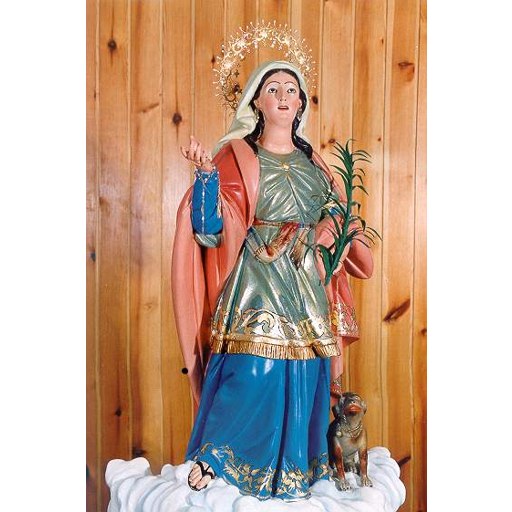
AnonymousUnknown author
License: Public domain
Quiteria
Saint- Feast Day
- 22 May
- Gender
- female
- Church
- Catholic
Places
Roles & Family
Patronage
rabies;people afflicted with rabies;against dog bites;Aire-sur-l'Adour;Higueruela
Biography
Saint Quiteria, known in French as Quitterie and in Portuguese as Quitéria, is a Christian virgin martyr whose cult is attested in the Roman Martyrology on 22 May, where she is described as having suffered at Aire in Gascony. Virtually nothing about her life can be established from contemporary historical sources. She is generally placed by tradition in the fifth century, in the late Roman or immediately post-Roman period in southwestern Gaul and the Iberian Peninsula. Modern historians treat the surviving biographies as medieval legend rather than as documentary history, while acknowledging that an early local cult at Aire-sur-l'Adour is plausible and that her name entered liturgical calendars by the early Middle Ages.
The Gascon tradition, centered on Aire-sur-l'Adour in what is now the French department of Landes, presents Quiteria as a young woman of high birth who consecrated her virginity to Christ and refused a marriage arranged by her pagan father. She fled, lived for a time in solitude, and was eventually captured and beheaded. In common with several other western cephalophoric saints, later tellings claim that she carried her own severed head to the place she had chosen for burial. A paleo-Christian sarcophagus preserved in the crypt of the church of Sainte-Quitterie at Aire-sur-l'Adour has long been associated with her relics. That church, a Romanesque structure later incorporated into the UNESCO-listed routes of Santiago de Compostela, became the principal focus of her medieval pilgrimage cult in France.
A separate and more elaborate legend developed in Galicia and Portugal. In this version Quiteria was one of nine sisters born at a single birth to Calsia, wife of a Roman official named Lucius Catellius Severus, said to have governed in Gallaecia. The mother, regarding the multiple birth as monstrous, ordered the infants drowned; a servant instead entrusted them to a Christian woman, who raised them in the faith. When they were grown, the sisters were identified, pressed to marry, and persecuted as Christians. Quiteria refused the husband chosen for her and was put to death by beheading. Some Portuguese popular versions further portray her as a warrior virgin who led Christian forces against her father's army before her capture and execution. The nine sisters—lists of names vary but commonly include Marina (often identified with Saint Marina of Aguas Santas), Quiteria, Germana, Genebra, Liberata, Victoria, Euphemia, and others—are widely regarded by scholars as a later hagiographic construct that bundled several independent local virgin-martyr cults into one family story.
Devotion to Quiteria spread widely in the medieval and early modern Catholic world, especially in France, Spain, and Portugal. She is invoked above all against rabies and the bites of mad dogs, a patronage that made her important in rural and pastoral communities. Numerous parishes, chapels, and municipalities in Portugal bear the name Santa Quitéria; Spanish devotion is found in various regions, including the town of Higueruela in Albacete. Portuguese and Spanish colonial expansion carried her cult to Brazil and other parts of Latin America, where churches and settlements were dedicated to her. Despite the legendary character of the narratives attached to her name, she continues to be honored as a fifth-century virgin martyr, with her feast observed on 22 May in local calendars and in popular piety.