Racho d'Autun is a saint of the Catholic Church (d. 660). Racho d'Autun's feast day is celebrated on 25 January.
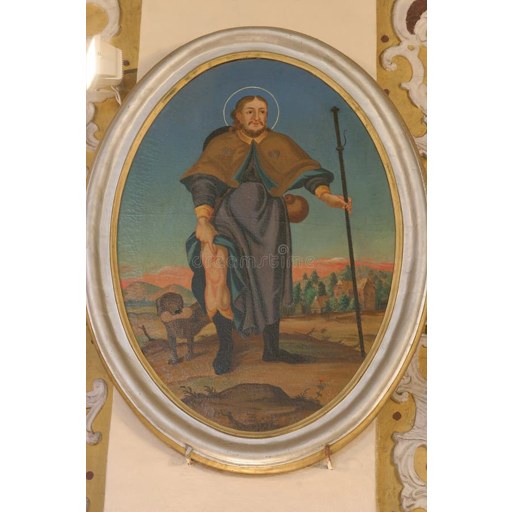
https://dreamstime.com/photos-images/saint-roch.html
License: unknown
Racho d'Autun
Saint- Life Span
- d. 660
- Feast Day
- 25 January
- Gender
- male
- Church
- Catholic
Places
Roles & Family
Biography
Racho of Autun, known in Latin as Ragnobertus and in French as Racho d'Autun or Saint Ragnobert, was a bishop of Autun in Burgundy during the seventh century. He belongs to the large number of Merovingian prelates whose names were preserved in diocesan catalogues and in the liturgy, but whose personal histories were never recorded in a surviving contemporary vita or chronicle. Traditional hagiographical and episcopal lists place his death in or about the year 660. The Germanic dithematic name Ragnobert was borne by members of the Frankish aristocracy, yet no charter, letter, or narrative source identifies his parents, birthplace, or the circumstances of his elevation to the episcopate.
Autun, the ancient Augustodunum, had been a major Gallo-Roman city and the seat of a bishop from late antiquity. In Racho's lifetime the diocese formed part of the ecclesiastical province of Lyon and lay within the Frankish kingdom of Burgundy, a region then subject to the shifting politics of Merovingian kings and their mayors of the palace. The sixth-century bishop Syagrius of Autun had been a figure of international standing, in correspondence with Pope Gregory the Great; two generations later the see would be occupied by Saint Leodegar, whose conflict with the Neustrian mayor Ebroin and whose martyrdom in the 670s made Autun famous. Racho's own episcopate falls in the comparatively poorly documented interval between those two better-known bishops. No conciliar signature, royal diploma, or narrative episode can be attached to him with certainty, and modern historians therefore treat the outline of his career as unknown.
Veneration of Racho was local before it was universal. He was commemorated as a holy bishop at Autun, and his name entered medieval martyrologies. In the Roman tradition his feast is observed on 25 January. Like the great majority of saints of the Merovingian church, he was honored by diocesan cult and popular reputation for holiness rather than by a formal process of canonization or beatification conducted in Rome; no pope is recorded as having issued a bull in his cause. Standard reference works do not assign him particular patronages of trades, illnesses, or places beyond his association with the church of Autun.
The scarcity of evidence is itself a historical fact. Seventh-century Burgundy produced saints whose passions and political entanglements were written down, and others, such as Racho, who remained names in a list. What can be said with confidence is that he held the see of Autun in the mid-seventh century, that the church of Autun remembered him as a saint, and that later Catholic calendars retained his feast. Responsible biography stops at that point and does not fill the silence with legend.