Rafael Merry del Val is a venerable of the Catholic Church (1865 - 1930).
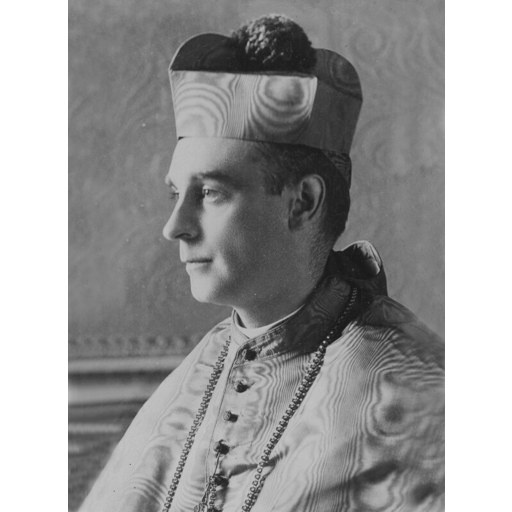
Unknown photographer
License: Public domain
Rafael Merry del Val
Venerable- Life Span
- 1865 - 1930 (age 65)
- Gender
- male
- Church
- Catholic
Places
Relics & Where to Venerate
Location unknown
The bodily remains of Rafael Merry del Val are a first-class relic. Venerated at Vatican Grotto.
Roles & Family
Biography
Rafael Merry del Val y Zulueta was born in London on 10 October 1865. His father, Rafael Carlos Merry del Val, belonged to a family of Irish origin that had settled in Spain and served in the Spanish diplomatic corps; his mother, Sofia Josefa de Zulueta, came from a Spanish family with ties to the Americas. Although born in England, he was a Spanish subject and grew up in the milieu of embassies. He received a cosmopolitan education in England, including studies at Ushaw College in County Durham, and then went to Rome to attend the Pontifical Gregorian University and the Pontifical Academy of Ecclesiastical Nobles, institutions that prepared clerics for curial and diplomatic careers. He was ordained a priest in December 1888 and entered the service of the Holy See while still a young man.
During the pontificate of Leo XIII, Merry del Val was employed in several delicate tasks. He acted as secretary of the commission appointed to study the validity of Anglican ordinations, an inquiry that issued in the bull Apostolicae Curae of 1896, which declared those orders invalid. In 1897 he was sent to Canada as apostolic delegate in connection with disputes over Catholic schools and other questions affecting the Church in North America. In 1900 he was named titular Archbishop of Nicaea and consecrated bishop. He also served as president of the Pontifical Academy of Ecclesiastical Nobles. At the conclave of 1903 he served as secretary. Pope Pius X, elected at that conclave, chose him almost immediately as Secretary of State and created him a cardinal in November 1903, assigning him the title of Santa Prassede. Merry del Val was then only thirty-eight years old.
As Cardinal Secretary of State from 1903 to 1914 he was the closest collaborator of Pius X. He supported the pope's determined opposition to theological Modernism, expressed in the decree Lamentabili sane exitu and the encyclical Pascendi Dominici Gregis in 1907 and in the Oath against Modernism imposed in 1910. In foreign affairs he confronted the French Law of Separation of 1905, which led to the breaking of diplomatic relations between France and the Holy See, and he dealt with anticlerical measures in other countries. His manner was often characterized as intransigent. After the death of Pius X and the election of Benedict XV in 1914, Merry del Val left the Secretariat of State. He was appointed Secretary of the Supreme Sacred Congregation of the Holy Office, the congregation charged with doctrinal questions, and Archpriest of the Vatican Basilica, posts he retained until his death.
In his later years Merry del Val continued to exercise influence in doctrinal matters through the Holy Office and to oversee the fabric of St. Peter's. He participated in the conclave of 1922 that elected Pius XI. He was noted for personal austerity and for a prayer known as the Litany of Humility, which is commonly attributed to him. He died in Vatican City on 26 February 1930 following an operation for appendicitis, at the age of sixty-four. He was buried in the grottoes of St. Peter's Basilica. A process for his beatification was subsequently introduced, and the Catholic Church recognizes him as a Servant of God. Historians regard him as a central figure of the pontificate of Pius X and of the Roman Curia's response to intellectual and political challenges in the early twentieth century.