Ralph Ashley is a blessed of the Catholic Church (d. 1606). Ralph Ashley's feast day is celebrated on 7 April.
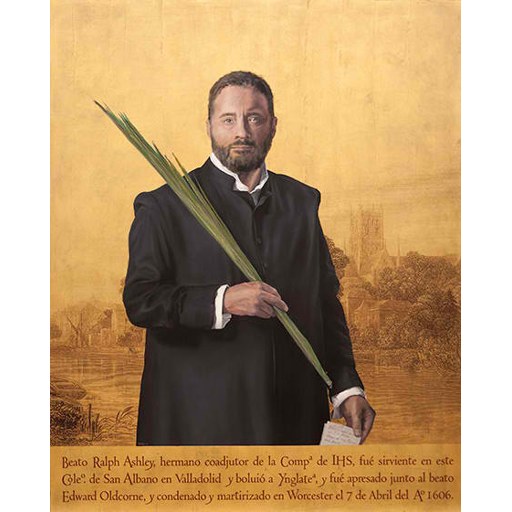
Royal English College in Valladolid
License: CC BY-SA 4.0
Ralph Ashley
Blessed- Life Span
- d. 1606
- Feast Day
- 7 April
- Gender
- male
- Church
- Catholic
Places
Roles & Family
Religious Information
Canonization
Biography
Ralph Ashley was an English Jesuit lay brother who was put to death at Worcester in 1606 and is venerated by the Catholic Church as a martyr of the penal period in England. Almost nothing can be established with certainty about his family, the place of his birth, or the year in which he was born. He trained as a cook and is known to have served in that capacity at the English College at Douai, then in the Spanish Netherlands, a principal centre for the education of English Catholics in exile. From Douai he went to Spain and was received at the English College at Valladolid. There, in the last decade of the sixteenth century, he entered the Society of Jesus as a temporal coadjutor, or lay brother. Jesuit lay brothers pronounced vows of poverty, chastity, and obedience and supported the order’s apostolic work in practical ways; they were not ordained to the priesthood.
Ashley was sent on the English mission and became the companion and servant of the Jesuit priest Edward Oldcorne. For some years the two lived at Hindlip Hall in Worcestershire, the seat of the recusant Habington family and a well-known refuge for Catholic clergy. The house contained elaborate hiding places, several of them constructed by the Jesuit lay brother Nicholas Owen. Ashley’s outward occupation remained that of a cook and household servant, a cover that allowed him to sustain Oldcorne’s ministry while attracting less notice than an ordained priest would have done. Under the statutes of Elizabeth I, continued under James I, it was high treason for a priest ordained abroad to enter England, and it was a serious offence to receive or assist such a priest.
After the Gunpowder Plot of November 1605, government searchers intensified their hunt for Jesuit missionaries. In January 1606 Sir Henry Bromley conducted a prolonged search of Hindlip Hall. After many days without food, four men were found in the hiding places: Henry Garnet, the Jesuit superior in England; Edward Oldcorne; Nicholas Owen; and Ralph Ashley. They were arrested and taken to the Tower of London, where they were interrogated and tortured. Owen died of his injuries. Ashley was racked as well. Neither he nor Oldcorne was shown to have had any part in the plot, but the authorities proceeded against the Jesuits discovered at Hindlip.
Ashley and Oldcorne were returned to Worcester for trial. Oldcorne was condemned as a priest and on charges of alleged conspiracy; Ashley was condemned for assisting a priest. On 7 April 1606 both were executed at Red Hill, Worcester, by hanging, drawing, and quartering. Contemporary reports describe Ashley as showing steadfast loyalty and affection toward Oldcorne at the place of execution. Pope Pius XI beatified Ralph Ashley on 15 December 1929 among a large group of English and Welsh martyrs of the sixteenth and seventeenth centuries. He is honoured as Blessed Ralph Ashley. His feast is kept on 7 April, the anniversary of his death, and he is also commemorated with other martyrs of England and Wales. He has not been canonized.