Ramon Llull is a blessed of the Catholic Church (1232 - 1316). Ramon Llull's feast day is celebrated on 30 June.
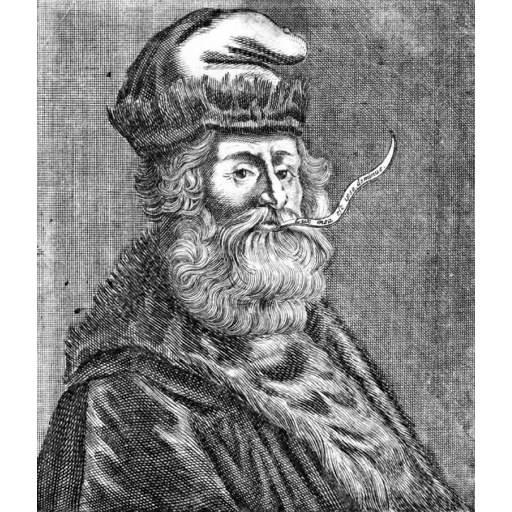
unknown (from the collection of Friderici Roth-Scholtzii Noriberg)
License: Public domain
Ramon Llull
Blessed- Life Span
- 1232 - 1316 (age 84)
- Feast Day
- 30 June
- Gender
- male
- Church
- Catholic
Places
Relics & Where to Venerate
Location unknown
The bodily remains of Ramon Llull are a first-class relic. Venerated at Basilica of St. Francis.
Roles & Family
Religious Information
Canonization
Biography
Ramon Llull was born in Palma, capital of the recently established Kingdom of Majorca, in the early 1230s, into a family of Catalan gentry that had settled on the island after the Aragonese-Catalan conquest of Muslim Mayurqa. As a young man he entered royal service, acting as a page and later in household office at the Majorcan court, and he participated in the worldly culture of the thirteenth-century Mediterranean courts as a troubadour poet. He married Blanca Picany and had two children, a son named Domènec and a daughter named Magdalena. The autobiographical Vita coetanea, which he later dictated, presents this courtly and familial phase as the setting for a sudden conversion that redirected the rest of his life.
In the early 1260s, according to that same account, Llull experienced repeated visions of Christ crucified. He formed three interlocking resolutions: to work for the conversion of non-Christians, above all Muslims, by reasoned persuasion rather than by crusade; to write a book capable of demonstrating Christian doctrine with compelling clarity; and to promote colleges in which missionaries would learn Arabic and other languages of the Islamic world. He made financial provision for his wife and children, undertook pilgrimage, and then spent years in study on Majorca, learning Arabic from a Muslim slave and training himself in Latin, philosophy, and theology. Out of this period came the first versions of his Ars Magna, a combinatorial art that arranged a limited set of general principles on rotating figures so that they could be combined to generate arguments, answer questions, and, in his intention, prove the articles of the Christian faith from premises he believed Muslims and Jews could also accept.
Llull became one of the most prolific writers of the European Middle Ages, composing in Catalan and Latin (and originally in Arabic, though those texts do not survive). His corpus includes mystical and utopian narrative such as Blanquerna, the encyclopedic Tree of Science, Felix or the Book of Wonders, the dialogue Book of the Gentile and the Three Wise Men, successive recastings of the Art culminating in the Ars generalis ultima, and a large body of sermons, poems, and controversial works. He is a foundational figure of Catalan prose literature. He travelled repeatedly through the western Mediterranean and to Paris, seeking royal and papal support for language colleges and for a missionary strategy based on disputation. A house of studies at Miramar on Majorca received royal backing. He lectured on the Art in Paris, was imprisoned after public preaching in Béjaïa, and at the Council of Vienne (1311–1312) saw the Church approve the teaching of Hebrew, Arabic, and Chaldean at major studia, a decision aligned with his long-standing program.
In old age he continued to write and to travel, including a final journey to Tunis. The place and manner of his death in 1315 or 1316 are not securely established: later hagiography described a stoning in North Africa and death as a martyr on the return voyage, while other traditions place his death at sea or on Majorca. He was buried in the Franciscan church of Palma, where his tomb is still shown. He lived and died as a lay member of the Third Order of Saint Francis, not as a priest or friar. Veneration of Blessed Ramon Llull grew in the Crown of Aragon and among Franciscans; his cult was confirmed in the nineteenth century by Pope Pius IX. Later readers, including Leibniz, studied his combinatorial method, and modern scholarship treats him as a major Mediterranean philosopher, missionary theorist, and precursor of systematic knowledge representation.