Raymond du Puy de Provence is a blessed of the Catholic Church (d. 1160).
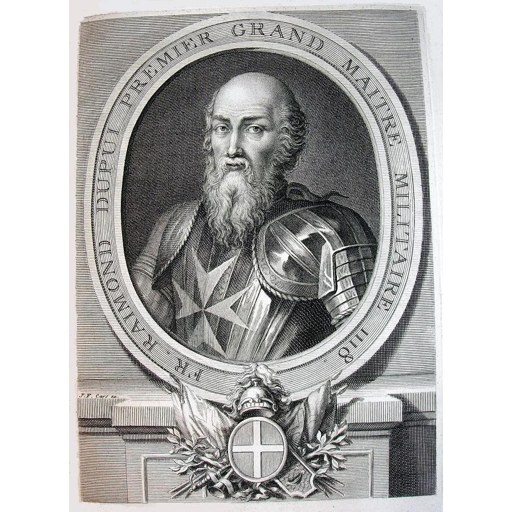
Laurent Cars (1699-1771), engraver
License: Public domain
Raymond du Puy de Provence
Blessed- Life Span
- d. 1160
- Gender
- male
- Church
- Catholic
Places
Roles & Family
Religious Information
Biography
Raymond du Puy, also known as Raymond of Puy or Raimundus de Podio, was a knight of French origin who became the second master of the Hospital of Saint John of Jerusalem, the religious community later known as the Knights Hospitaller. He succeeded Blessed Gerard, the founder of the Hospital, around the year 1120. Later tradition often places his birth in the late eleventh century and associates his family with the Dauphiné or with Provence in southeastern France; the surname du Puy has also been linked by some writers to Le Puy-en-Velay. Contemporary documentation of his parentage and exact birthplace is lacking, and the details of his early life before he appears as head of the Hospital remain obscure.
Under Raymond's lengthy government, which lasted until about 1160, the Hospital evolved from a largely charitable brotherhood devoted to the care of poor and sick pilgrims in Jerusalem into a military-religious order of the Latin East. He is traditionally credited with giving the community its first written rule, a text dependent on Augustinian models that regulated prayer, hospitality, and common life, and with distinguishing the brothers into classes of knights, chaplains, and sergeants. During the same period the Hospitallers assumed an explicit military role in the defense of the Kingdom of Jerusalem, fighting alongside other Crusader forces and beginning to hold and garrison fortresses, while continuing their original work of maintaining hospitals. Papal support, building on the recognition already granted to the Hospital in the early twelfth century, confirmed the order's privileges and its independence from local ecclesiastical control.
Raymond's mastership coincided with the consolidation of the Crusader states after the First Crusade and with the growing need for standing military institutions in Syria and Palestine. The order acquired estates and commanderies in the East and, increasingly, in western Europe, creating a trans-Mediterranean network that supplied men and revenues to the Holy Land. Hospitaller contingents took part in the campaigns of the Latin kings of Jerusalem, and the black habit marked with a white cross became the distinctive dress of the brothers. Surviving evidence for Raymond's personal deeds is thin; much of the narrative of his career was shaped by later official histories of the order, which present him as the legislator who completed Gerard's foundation and as the master who made the Hospital a military power.
He died about 1160, after some four decades at the head of the order, and was succeeded by Auger de Balben. The place of his death and burial is not securely recorded in contemporary sources, though he is presumed to have died while still in office in the East. In the later tradition of the Order of Saint John and of the Sovereign Military Order of Malta he is remembered as a foundational figure, sometimes styled blessed in internal commemorations, but he does not have a clearly documented universal cult, an officially assigned feast day in the general Roman calendar, or a recorded act of papal canonization or beatification that can be verified with certainty. Historical knowledge of Raymond thus rests on a small number of twelfth-century references, on the statutes associated with his name, and on the institutional memory of the Hospitallers rather than on a full contemporary biography.