Raymond of Penyafort is a saint of the Catholic Church (1175 - 1275). Raymond of Penyafort's feast day is celebrated on 7 January. Raymond of Penyafort is the patron saint of canon lawyers;lawyers;medical record librarians;Barcelona.
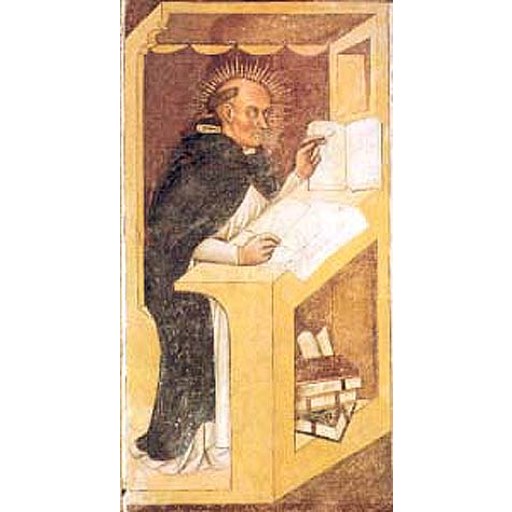
Tommaso da Modena
License: Public domain
Raymond of Penyafort
Saint- Life Span
- 1175 - 1275 (age 100)
- Feast Day
- 7 January
- Gender
- male
- Church
- Catholic
Places
Relics & Where to Venerate
Location unknown
The bodily remains of Raymond of Penyafort are a first-class relic. Venerated at Cathedral of the Holy Cross and Saint Eulalia.
Roles & Family
Religious Information
Patronage
canon lawyers;lawyers;medical record librarians;Barcelona
Canonization
Biography
Raymond of Penyafort was a Catalan Dominican friar and one of the foremost canonists of the thirteenth century. He was born about 1175 at the castle of Penyafort, near Vilafranca del Penedès in Catalonia, then part of the Crown of Aragon, to a noble family connected with the counts of Barcelona. After early studies and a period of teaching in Barcelona, he went to the University of Bologna, Europe’s leading school of law, where he studied and later taught both civil and canon law. Returning to Catalonia, he served as a canon and archdeacon of Barcelona cathedral and put his legal training to use in the administration of the local church.
In or about 1222 he entered the recently founded Order of Preachers. As a Dominican he composed the Summa de casibus poenitentiae, a practical manual that helped confessors apply ecclesiastical law to cases of conscience and that circulated widely in several recensions. Around 1230 Pope Gregory IX called him to Rome, appointed him papal chaplain and penitentiary, and commissioned him to gather the decretals issued since Gratian into a single official collection. Raymond arranged this mass of papal legislation into five books. Promulgated in 1234 as the Decretals of Gregory IX, or Liber Extra, the compilation became the core of the Corpus Iuris Canonici and remained the principal body of Latin canon law until the Code of 1917.
In 1238 the Dominican general chapter elected him third Master General of the order, succeeding Jordan of Saxony. He recast the Dominican constitutions into a coherent form that endured for centuries and worked to organize the order’s missions. Pleading advanced age, he resigned in 1240 and returned to Catalonia. There he advised King James I of Aragon, promoted the study of Arabic and Hebrew among Dominican missionaries preaching to Muslims and Jews, and was traditionally credited with encouraging Thomas Aquinas to write the Summa contra Gentiles as an aid to that work. He also took part in establishing the papal inquisition in the Crown of Aragon and was associated with the early history of the Mercedarians, founded to ransom Christian captives.
Raymond spent his last decades in Barcelona, remaining active as a preacher, confessor, and counsellor. He died there on 6 January 1275, at an age contemporaries regarded as close to one hundred years, and was buried in the cathedral of Barcelona, where his tomb became a focus of devotion. Pope Clement VIII canonized him in 1601. The Catholic Church observes his feast on 7 January. He is invoked as patron of canon lawyers and of lawyers more generally, and as a patron of Barcelona.