Raymond of Toulouse is a saint of the Catholic Church (d. 1118). Raymond of Toulouse's feast day is celebrated on 3 July.
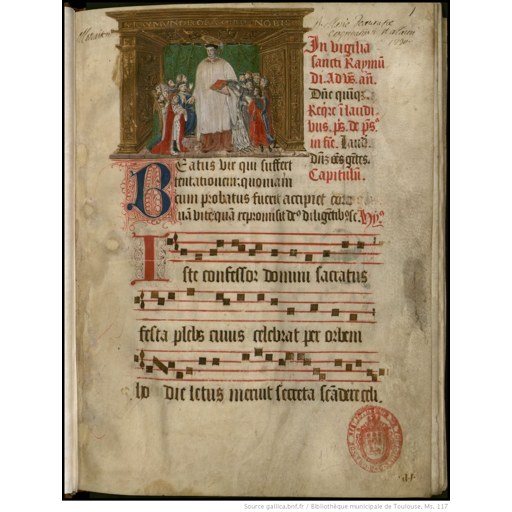
License: Public domain
Raymond of Toulouse
Saint- Life Span
- d. 1118
- Feast Day
- 3 July
- Gender
- male
- Church
- Catholic
Places
Roles & Family
Religious Information
Biography
Raymond of Toulouse, also known as Raymond Gayrard (Raimond Gayrard; in Latin, Raimundus Gayrardus), was a Catholic saint of the later eleventh and early twelfth centuries, closely associated with the basilica of Saint-Sernin (Saint Saturninus) in Toulouse in southern France. He was a native of Toulouse. No reliable source records the year of his birth or the names of his parents, and almost nothing can be verified about his childhood or education. In adult life he served as chanter, or cantor, at Saint-Sernin, then as now one of the principal churches of the city and an important station on the pilgrimage roads of western Europe, including the Via Tolosana toward Santiago de Compostela.
He was married and lived as a layman while discharging his duties at the basilica. After his wife’s death he embraced a more fully ecclesiastical life and was received as a canon of Saint-Sernin. In this period the chapter of Saint-Sernin followed a regular common life associated with the Rule of Saint Augustine. As a canon, Raymond became known for charity toward the poor and toward pilgrims. He founded a hospital or hospice near the basilica to shelter and care for the needy and for travelers, a work that matched both the pastoral concerns of the chapter and Toulouse’s growing place on the pilgrimage routes.
He is also remembered in later tradition for his part in the reconstruction of the Basilica of Saint-Sernin. The present great Romanesque church was under construction from the later eleventh century and ranks among the largest churches of its type. Hagiographical accounts credit Raymond with advancing or overseeing building work on the church, including efforts connected with restoration or completion of the fabric. His combination of liturgical service, care for the poor, and support of the basilica made him a notable figure in the religious life of Toulouse at the turn of the twelfth century. Independent contemporary documentation of his career remains sparse, and much of what is repeated about him depends on later local tradition.
He died in Toulouse on 3 July 1118, the date most commonly given in hagiographical sources, and was buried in the Basilica of Saint-Sernin. A local cult formed around his tomb. His feast is kept on 3 July. He was not the subject of a well-documented papal canonization of the later medieval or modern kind; recognition as a saint rests on traditional veneration in Toulouse and on later inclusion in martyrologies and calendars. Specific patronages beyond his association with Toulouse and Saint-Sernin, and the name of his wife, are not securely attested.