Raynerius of Split is a saint of the Catholic Church (d. 1180). Raynerius of Split's feast day is celebrated on 4 August.
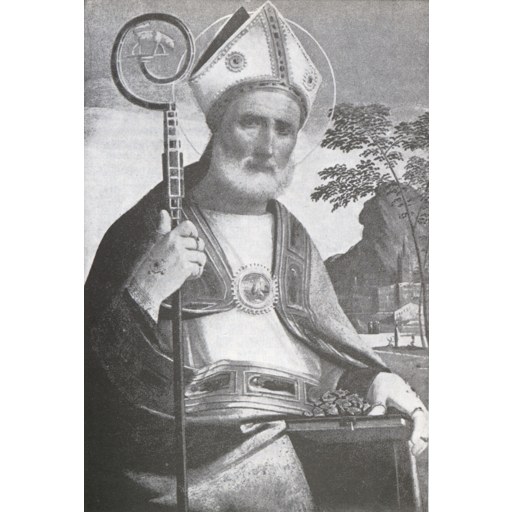
Editore: Neuland-Bund u. Verlag Bosl KG
License: Public domain
Raynerius of Split
Saint- Life Span
- d. 1180
- Feast Day
- 4 August
- Gender
- male
- Church
- Catholic
Places
Roles & Family
Religious Information
Biography
Raynerius of Split, also known as Rainerius, Raniero, Rainerius of Cagli, or by the Croatian name Arnir, was a twelfth-century Italian monk and prelate who became archbishop of Split in Dalmatia and was venerated after his death as a martyr. Surviving sources do not record the year or the precise place of his birth. He is described as a native of Italy who entered the eremitical community of Fonte Avellana in the Apennines. That house belonged to the reform tradition associated with Saint Romuald and with Saint Peter Damian, who had been prior there in the eleventh century; later tradition identifies Raynerius with the Camaldolese family of Benedictine monasticism. From Fonte Avellana he was appointed bishop of Cagli, a diocese in the March of Ancona.
In 1175 Pope Alexander III translated him from Cagli to the metropolitan see of Split, then usually called Spalato, the chief Latin archbishopric on the Dalmatian coast. Split at that period formed part of the Kingdom of Hungary, which held the Croatian crown, while the city itself was developing the institutions of a Dalmatian commune. The archbishops of Split claimed wide spiritual jurisdiction and substantial landed estates, many of which had come under the control of local noble lineages and of the urban community. Raynerius attempted to recover these properties and to enforce ecclesiastical rights, a course that set him against powerful interests in the city.
The resulting enmity ended in his murder. On 4 August 1180 he was attacked and killed by a mob of the citizens of Split. The principal narrative source for these events is the Historia Salonitana of Thomas the Archdeacon, a thirteenth-century chronicler of the church of Split, who portrays Raynerius as a man of outstanding holiness and treats his death as a martyrdom undergone in defense of the Church. Later hagiographic retellings add further details of the assault, which are not all independently verifiable; the date, the Italian origin of the archbishop, and the responsibility of the Spalatin populace are the elements most securely attested.
Raynerius was thereafter honored as a saint and martyr, particularly in Dalmatia and among communities that claimed the Camaldolese heritage. His feast day is 4 August. He belongs to the large number of medieval bishops whose cult arose by local veneration rather than by a formal process of papal canonization of the kind that became standard in later centuries. Consistent with his life as a monk and as a bishop of the Latin Church, there is no evidence that he married or had children. He did not hold the office of pope or of patriarch.