Regimbald is a blessed of the Catholic Church (d. 1039). Regimbald's feast day is celebrated on 13 October.
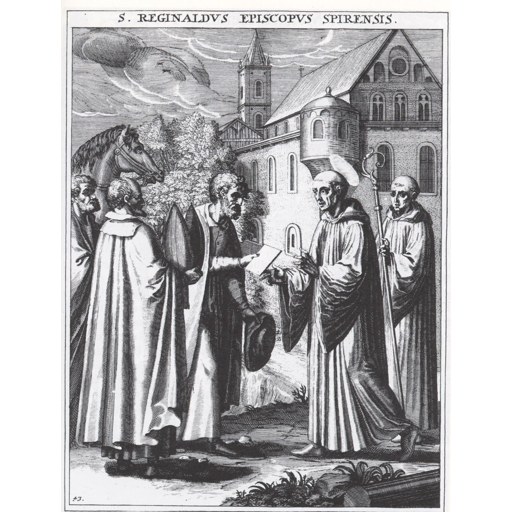
Matthäus Rader
License: Public domain
Regimbald
Blessed- Life Span
- d. 1039
- Feast Day
- 13 October
- Gender
- male
- Church
- Catholic
Places
Roles & Family
Religious Information
Biography
Reginbald, also written Regimbald or Reginbald II, was a Benedictine monk and bishop who governed the Diocese of Speyer in the second quarter of the eleventh century. He is called Reginbald II to distinguish him from an earlier Bishop Reginbald of Speyer who had held the same see in the tenth century. Later medieval and modern catalogues identify him with the Swabian comital house of Dillingen, a family already distinguished in church history by Saint Ulrich of Augsburg. No contemporary record preserves the year or place of his birth, and nothing reliable is known of his childhood.
He received the monastic habit at the Benedictine abbey of Saints Ulrich and Afra in Augsburg, a house closely associated with the cult of Saint Ulrich and with reform currents in Swabian monasticism. From that community he was advanced to abbatial office. He is recorded as abbot of the Benedictine monastery of Ebersberg in Bavaria and thereafter as abbot of Lorsch, the great imperial abbey on the Rhine whose abbots ranked among the foremost prelates of the East Frankish and Salian realms. These successive dignities indicate that he was regarded as a capable monastic superior and that he moved in the orbit of the imperial church.
Emperor Conrad II named him Bishop of Speyer in 1032 or 1033, after the death of Bishop Walter. Speyer was then rising in importance as a favoured church of the new Salian dynasty; Conrad II had begun the rebuilding of Speyer Cathedral as an imperial burial church around 1030, and Reginbald’s short pontificate therefore fell in the first decade of that vast building project. Written sources for his acts as bishop are meagre. Hagiographical tradition, formed in the diocese in later centuries, describes him as a man of piety and learning, a portrait that fits his long Benedictine career but cannot be filled out with independently documented episodes, synods, or writings.
Reginbald died on 13 October 1039, after some six years in the episcopal office. He was commemorated as a saint in the Diocese of Speyer, and his feast was kept on the anniversary of his death. No papal bull of canonization from the later centralized process is known; his cult is of the local kind customary for holy bishops of the eleventh century. Beyond the outline of his monastic and episcopal career, the surviving evidence does not permit a fuller biography, and claims about specific miracles, pastoral initiatives, or a precise place of burial are not securely grounded in early sources.