Regintrud is a saint of the Catholic Church.
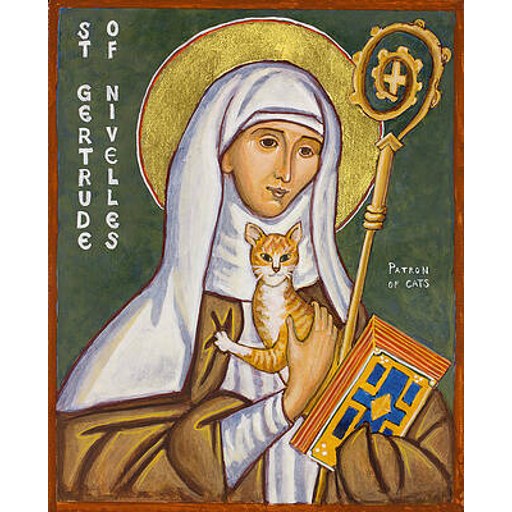
https://fineartamerica.com/art/paintings/saint+gertrude
License: unknown
Regintrud
Saint- Gender
- female
- Church
- Catholic
Roles & Family
Religious Information
Biography
Regintrud, also recorded in the sources as Reginlind or Regentrud, was a noblewoman of the late Merovingian period whose life is associated with the Agilolfing dukes of Bavaria in the late seventh and early eighth centuries. Contemporary documentation is extremely limited, and later medieval genealogies as well as modern historical reconstructions disagree on fundamental points of her biography. She is most frequently identified as the consort of Duke Theodo of Bavaria, a ruler who appears in Frankish and Bavarian sources of the period and who is credited with organizing the duchy and supporting the missionary work of Saint Rupert in Salzburg. Because the surviving evidence consists largely of later notices, charter traditions, and onomastic arguments, even this marital identification is presented by historians as probable rather than certain.
The ancestry of Regintrud is likewise unresolved. One long-standing hypothesis, found in some genealogical compilations, makes her a daughter of the Merovingian king Dagobert I, thereby linking the Bavarian ducal house to Frankish royalty. Other reconstructions connect her with the family of the Frankish noble Hugobert and Irmina of Oeren, or regard her as a member of a leading Bavarian or neighboring aristocratic kin-group. None of these proposals rests on an unambiguous contemporary statement. If she was indeed Theodo's wife, she is regarded as the mother of the sons among whom the duchy was later divided, namely Theodbert, Grimoald, Theudebald, and Tassilo. These princes appear in eighth-century records as dukes or co-rulers in different portions of Bavaria, and their careers form the principal context in which Regintrud's name is remembered.
After Theodo's death in the early eighth century, certain later traditions hold that Regintrud entered religious life and became associated with Nonnberg Abbey in Salzburg, a community of women founded in connection with Rupert's mission and following the Benedictine rule. A woman of the same name is attested in the early history of that house, and some scholars have identified the duchess with an abbess Regintrud. Other historians treat the duchess and the abbess as distinct persons whose identities were subsequently conflated. The evidence does not allow a firm decision. No contemporary vita or liturgical notice establishes a formal cult, and Regintrud does not appear with a universally recognized feast day in the major martyrologies.
Regintrud's importance for the historian therefore lies in her position at the intersection of Agilolfing dynastic politics, Frankish influence, and the Christianization of Bavaria around the turn of the eighth century. She illustrates the role of high-born women as links between ruling families and as potential patrons or members of the first monastic foundations in the eastern Alpine region. At the same time, the gaps and contradictions in the record serve as a reminder of how little can be known with certainty about even prominent figures of this era. Later writers who sought to reconstruct the pedigree of the Bavarian dukes repeatedly invoked her name, yet the cautious historian must acknowledge that much of the traditional picture remains conjectural.