Regnobert de Bayeux is a saint of the Catholic Church (d. 666). Regnobert de Bayeux's feast day is celebrated on 24 May.
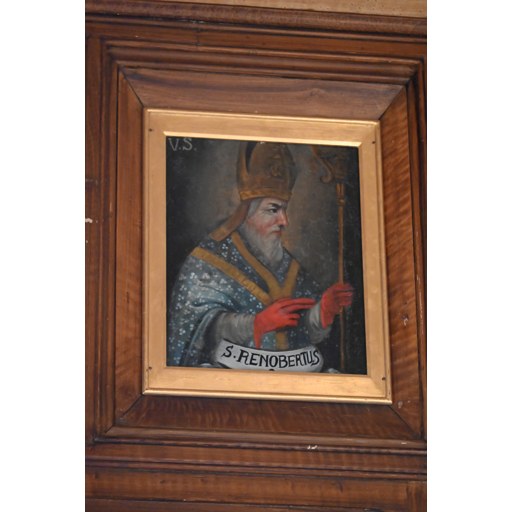
Giogo
License: CC BY-SA 4.0
Regnobert de Bayeux
Saint- Life Span
- d. 666
- Feast Day
- 24 May
- Gender
- male
- Church
- Catholic
Places
Roles & Family
Biography
Saint Regnobert of Bayeux, known in French as Saint Rénobert and in Latin as Regnobertus (also Ragnobert or Renobert), was a bishop of Bayeux in Normandy during the Merovingian period. He is honoured as a saint in the Roman Catholic Church. Almost nothing can be established about his origins, family, or early life; even the century of his episcopate is known only through later tradition, which places him in the seventh century. The Germanic form of his name is consistent with Frankish identity, which would be expected of a prelate in Neustria, but no contemporary document records his parentage or birthplace. Traditional notices commonly give the year of his death as 666, a date repeated in martyrologies, saint directories, and older diocesan histories, though it is not confirmed by a source written in his own age.
The early episcopal succession of Bayeux is poorly documented. Medieval catalogues of the see, compiled centuries after the events they purport to describe, insert Regnobert among the first bishops, after missionary figures such as Saint Exuperius and Saint Vigor and, in some lists, after Saint Lupus. Those catalogues are not independent seventh-century records, and modern historians treat their chronology with caution. Within that traditional framework Regnobert is presented as a pastor of the Bessin at a time when episcopal organisation in western Neustria was still taking durable shape, and when the cults of local bishop-saints were becoming focal points of diocesan identity. He would have exercised ministry in a landscape still marked by the incomplete Christianisation of rural districts and by the close ties between Frankish aristocrats and the episcopal office.
No contemporary vita of Regnobert has survived, and later notices are short. He is remembered as a holy bishop rather than through an elaborate cycle of miracle stories or foundation legends. His relics were kept at Bayeux and were translated during the Middle Ages; his memory was attached to the cathedral church and to churches under his invocation in the region. His feast is observed on 24 May. Formal papal canonisation in the later medieval or modern sense does not apply: like most Merovingian bishop-saints, he belongs to the era of local cult and popular acclamation, later received into diocesan calendars.
Because the written evidence is so limited, a careful account must distinguish local cult from recoverable biography. What is reasonably secure is that the church of Bayeux venerated Regnobert as one of its early bishops and saints, that this cult was already established by the central Middle Ages, and that it formed part of the same commemorative landscape as the better-attested cult of Saint Vigor. Claims about precise acts of church foundation, miracles, attendance at particular councils, or a detailed personal career are not supported by early evidence and should not be treated as historical fact. His importance lies in the continuity of episcopal memory in the Bessin and in the medieval devotion that preserved his name when almost every other biographical detail had been lost.