Richard of Chichester is a saint of the Catholic Church (1197 - 1253). Richard of Chichester's feast day is celebrated on 3 April. Richard of Chichester is the patron saint of Sussex;Chichester;Diocese of Chichester.
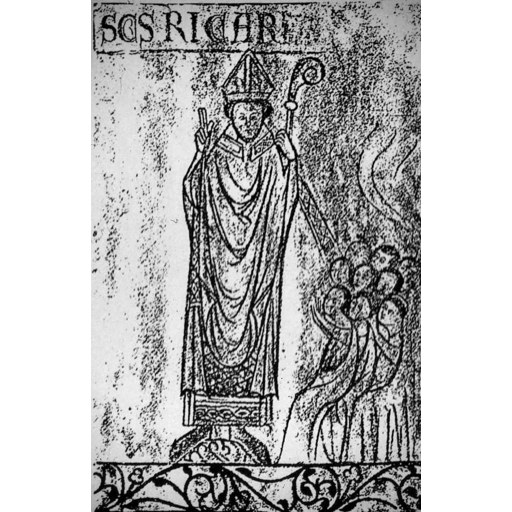
Unknown authorUnknown author
License: Public domain
Richard of Chichester
Saint- Life Span
- 1197 - 1253 (age 56)
- Feast Day
- 3 April
- Gender
- male
- Church
- Catholic
Places
Relics & Where to Venerate
Location unknown
It is here that local tradition holds remains of the saint are to be found: The Lady Chapel not only contains the Saxon Cross but also an ancient broken marble slab engraved with a Bishop's pastoral staff and a Greek cross believed to have come from a reliquary containing the relics of St
Roles & Family
Patronage
Sussex;Chichester;Diocese of Chichester
Canonization
Biography
Richard of Chichester, known in his own day as Richard de Wych (or de Wicio), was born in 1197 at Droitwich—then commonly called Wych—in Worcestershire, in the west of England. His family held land of some local importance, but both of his parents died while he was still young, and a negligent guardian allowed the estate to fall into decay. Richard himself took to farm labour in order to recover the property for his elder brother. When that brother later urged him to accept an advantageous marriage that would have restored the family's wealth, Richard declined. He had already formed the intention of a scholarly and clerical life. He proceeded to the schools of Oxford, where he lived in such poverty that he and his companions were said to share a single gown and a meagre diet, then to Paris, and finally to Bologna, the great centre of legal study, where he became a doctor of canon law. After his return he was chosen chancellor of the University of Oxford.
His learning and austerity brought him to the notice of Edmund of Abingdon, archbishop of Canterbury, who made him chancellor of the archdiocese. Richard served Edmund with close personal loyalty, accompanied him when the archbishop went into exile in France, and was with him at Soissy at the time of Edmund's death in 1240. Remaining in France, Richard studied theology in the Dominican house at Orléans and was ordained priest there. He then returned to England and undertook parochial work in Kent, serving the churches of Charing and of Deal. Boniface of Savoy, Edmund's successor at Canterbury, recalled him to the chancellorship. In 1244 the chapter of Chichester elected Richard as their bishop. King Henry III, determined to place his own servant Robert Passelewe in the see, rejected the election, confiscated the temporalities, and forbade Richard's admission. Richard appealed to the papal court. At Lyons, during the council held there in 1245, Pope Innocent IV confirmed him and consecrated him bishop. Even after his return Henry continued to withhold the revenues for some two years. Richard lodged with a priest named Simon at Tarring, near Worthing, and administered his diocese as a poor itinerant pastor until the king, faced with papal sanctions, restored the temporalities in 1246.
Once in possession of his see, Richard governed with a combination of personal severity and pastoral energy that impressed contemporaries. He convened synods and published constitutions that required priests to reside, to know the words of the sacraments, to instruct the people, and to live chastely; he opposed the holding of multiple benefices. He was remembered for hospitality to the poor, for simplicity of dress and table, and for a habit of travelling his diocese on foot. He contributed to the repair of Chichester Cathedral, which had suffered from fire, and he fostered the cult of Saint Edmund, whose example had formed him. In the last year of his life he accepted a papal commission to preach the crusade in England, following the call associated with King Louis IX of France. While engaged in that preaching he reached Dover, fell ill, and died on 3 April 1253 in the hospital of the Maison Dieu. He was buried in Chichester Cathedral.
Almost at once cures and other wonders were reported at his tomb. A formal process followed, and Pope Urban IV canonized Richard in 1262. In 1276 his body was translated to a richly adorned shrine behind the high altar of the cathedral; the shrine drew pilgrims from across England until it was demolished in 1538 during the Reformation. Richard's principal feast is 3 April, the day of his death; many Anglican calendars also mark 16 June, the date of the translation. He is venerated as the patron saint of Sussex and of the Diocese of Chichester. A short prayer of thanksgiving to Christ, traditionally ascribed to Richard as he lay dying and asking that the petitioner may know, love, and follow Jesus more nearly, has remained in continuous use, particularly in Sussex, and has become one of the best-known English medieval prayers.