Richard Rolle is a saint of the Catholic Church (d. 1349). Richard Rolle's feast day is celebrated on 20 January.
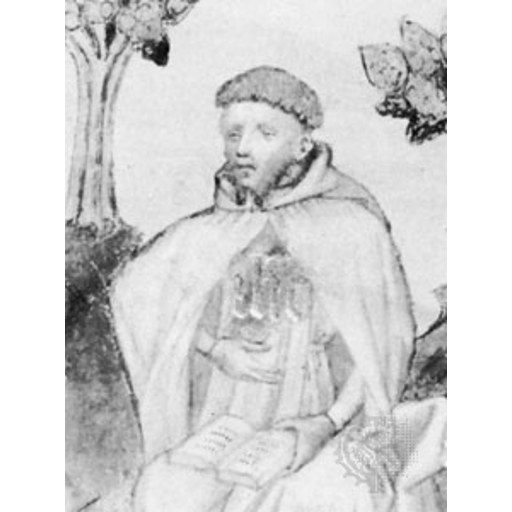
License: Public domain
Richard Rolle
Saint- Life Span
- d. 1349
- Feast Day
- 20 January
- Gender
- male
- Church
- Catholic
Places
Roles & Family
Biography
Richard Rolle was an English hermit, mystic, and religious writer of the fourteenth century, frequently described as the earliest of the major English mystics of the later Middle Ages. He was born around the opening of that century at Thornton in Yorkshire, a place generally identified by modern scholars as Thornton-le-Dale near Pickering in the North Riding. His family appears to have been of modest but sufficient means to allow him an education. As a youth he was sent to the University of Oxford with the support of Thomas de Neville, Archdeacon of Durham. He left the university without taking a degree, apparently finding scholastic disputation unsatisfying and feeling a strong call to contemplative solitude. The principal narrative of his early life comes from the liturgical Office compiled at Hampole some decades after his death in the hope of canonization. According to that account, he returned home, cut up two of his sister's tunics—one white and one grey—and, adding his father's rain-hood, made himself a hermit's habit, then fled to take up the eremitical life.
He was recognized and assisted by John de Dalton of Pickering, who had known him at Oxford and who furnished him with a cell and the simple necessities of a hermit. Rolle subsequently lived as a solitary in various locations in northern England, moving from place to place rather than remaining in a single enclosed cell for his entire career. He reported distinctive mystical experiences which he named calor (an inner heat), dulcor (sweetness), and canor (an infused heavenly song or harmony), insisting that these were spiritual gifts of love and not merely bodily phenomena. These themes dominate his Latin treatise Incendium Amoris, known in English as The Fire of Love, which became his most celebrated work. He also produced other Latin writings, among them Emendatio Vitae (The Mending of Life), commentaries on the Psalter, Job, the Song of Songs, and the Apocalypse, and a number of shorter pieces. In a notable departure from the usual practice of learned clergy, he wrote extensively in Middle English so that nuns and devout laypeople who did not read Latin might have access to spiritual instruction. His English works include The Form of Living, Ego Dormio, The Commandment, and a complete English Psalter with commentary.
In his later years Rolle took up residence near the Cistercian nunnery of Hampole, not far from Doncaster. There he acted as spiritual director to the community. He was particularly associated with Margaret Kirkby, a Hampole nun who became an anchoress, first at East Layton and later at Anderby in Richmondshire; The Form of Living was written for her. Rolle died at Hampole in 1349, in the year of the first great visitation of the Black Death in England, and was buried at the priory. He does not appear to have belonged to any canonical religious order; his vocation was that of a hermit living under no formal monastic rule, though he was closely linked in his last years with the Cistercian nuns.
After his death a cult grew up around his tomb. The nuns of Hampole assembled miracle stories and biographical lessons into an Office intended to support a petition for papal canonization, but no formal canonization or beatification was ever granted by Rome. Despite the absence of official recognition, Rolle's writings enjoyed an exceptionally wide manuscript circulation in fifteenth-century England and were among the most copied vernacular spiritual texts of the period. He stands at the head of the fourteenth-century English mystical tradition that also includes Walter Hilton, the anonymous author of The Cloud of Unknowing, and Julian of Norwich. The Church of England commemorates him as a spiritual writer on 20 January.