Rictius Varus is a saint of the Catholic Church.
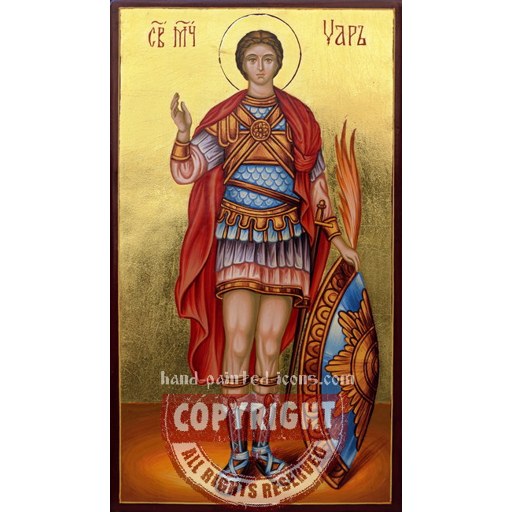
https://hand-painted-icons.com/category/saints-and-angels/saint-varus-28x16cm/
License: unknown
Rictius Varus
Saint- Gender
- male
- Church
- Catholic
Places
Roles & Family
Biography
Rictius Varus, also transmitted in Latin sources as Rictiovarus, is a Roman official of the later third and early fourth centuries who appears in the hagiographical literature of northern Gaul. The passions of several Gallic martyrs present him as a vicarius or as a prefect of the praetorium charged with enforcing the anti-Christian edicts of the Tetrarchy, especially those associated with the Great Persecution under Diocletian and Maximian around the opening years of the fourth century. No contemporary inscription, legal rescript, or administrative list independently confirms his career, so the titles and the chronology rest on the internal claims of the passiones rather than on the secular documentary record. Modern historians therefore commonly treat him as a stock persecutor-figure of the Gallic martyr narratives, even while allowing that a magistrate of that name or a similar function may have operated in Belgica and neighboring provinces during the persecution.
In those legendary accounts he holds tribunals in a series of cities of northern Gaul and subjects Christians to interrogation, torture, and execution when they refuse to sacrifice to the gods. His name is attached to the passion narratives of Quentin of Vermand (Saint Quentin), the shoemaker brothers Crispin and Crispinian of Soissons, Fuscian, Victoricus and Gentian associated with the region of Amiens, Lucian of Beauvais, Piat of Tournai, and other local martyrs of Belgica. The texts portray him as unusually severe, a literary role that unifies a cluster of northern Gallic cults dated by tradition to the same imperial crisis. Because the passions were written or substantially rewritten well after the events they claim to describe, the speeches, tortures, and itineraries they assign to him cannot be read as court minutes; they remain important evidence for how later communities remembered the persecution rather than for the day-to-day acts of a verifiable official.
A secondary and still later strand of the tradition asserts that Rictius Varus was himself converted by the constancy of the martyrs or by miraculous signs, received baptism, and was put to death for the Christian faith. That conversion-and-martyrdom motif is characteristic of medieval elaborations of earlier persecution stories and is not present in the earliest recoverable layers of the Gallic passiones. It cannot be verified from reliable historical evidence, and it may reflect a pious desire to reclaim a notorious antagonist rather than an independent memory of the man’s end. Consequently, neither a date nor a place of death can be established, nor can a burial site.
Almost nothing else of a personal kind is known. Place and date of birth, family origin, marriage, and children are unrecorded. He is not attested as a member of a religious order, as Bishop of Rome, or as patriarch of any Eastern see. Whether he ever became the object of a stable liturgical cult as a saint in his own right is uncertain: he does not occupy a secure, universally recognized place in the principal martyrologies, and attributions of a feast day are inconsistent or absent from standard calendars. No reliable list of patronages is attached to him. His historical interest therefore lies less in a reconstructable biography than in his function as the narrative antagonist who binds together a large family of northern Gallic martyr legends set in the age of Diocletian and Maximian.