Robert Lawrence is a saint of the Catholic Church (d. 1535). Robert Lawrence's feast day is celebrated on 4 May.
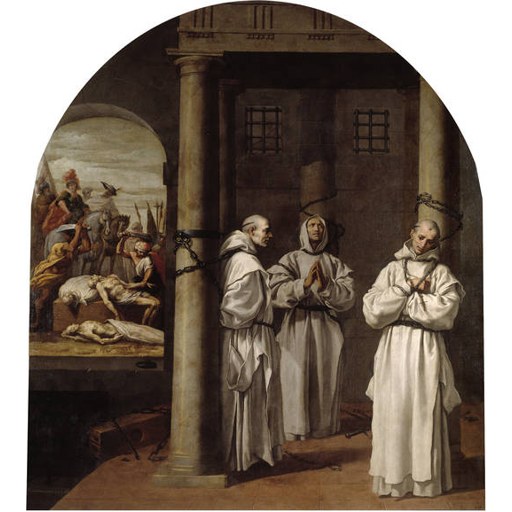
Vincenzo Carducci
License: Public domain
Robert Lawrence
Saint- Life Span
- d. 1535
- Feast Day
- 4 May
- Gender
- male
- Church
- Catholic
Places
Roles & Family
Religious Information
Canonization
Biography
Robert Lawrence was an English Carthusian monk and priest of the early sixteenth century, remembered as prior of Beauvale Charterhouse in Nottinghamshire and as one of the first Catholics put to death under Henry VIII’s assertion of royal supremacy over the Church in England. Almost nothing reliable survives about his family, education, or the date and place of his birth; he enters the historical record as a formed Carthusian already holding office. The Carthusians, a strictly contemplative order living in solitude under the rule associated with Saint Bruno, enjoyed a high reputation in late medieval England for austerity and regularity. Beauvale, a modest fourteenth-century foundation, was one of the smaller English charterhouses. As prior, Lawrence was charged with the spiritual and temporal care of that community at the moment when Tudor legislation began to demand an oath acknowledging the king as Supreme Head of the Church of England.
After the Act of Supremacy of 1534 and the accompanying Treasons Act, the London Charterhouse under Prior John Houghton became a centre of conscientious resistance. Lawrence, together with Augustine Webster, prior of the Charterhouse of Axholme in Lincolnshire, went to London to confer with Houghton. The three priors then sought an interview with Thomas Cromwell in the hope of obtaining some exemption or mitigation of the oath for their houses. They were instead arrested and confined in the Tower of London. Their refusal to swear was treated as high treason. On 29 April 1535 they were tried at Westminster with Richard Reynolds, a Bridgettine of Syon Abbey, and John Haile, the secular vicar of Isleworth; all were condemned.
On 4 May 1535 the five men were drawn on hurdles from the Tower to the gallows at Tyburn and there hanged, cut down while still living, disembowelled, beheaded, and quartered, the full statutory penalty for treason. Catholic tradition regards this group, and the Carthusians in particular, as the first martyrs of the English Reformation, preceding the executions of John Fisher and Thomas More later the same year. Contemporary and near-contemporary accounts stress the composure of the Carthusian priors. Lawrence’s remains, like those of his companions, were subjected to the customary public display of quarters. Further members of the English Carthusian province were imprisoned, starved, or executed in 1537 and after, so that Lawrence belongs to a larger company of Carthusian martyrs of the Henrician period.
He was beatified by Pope Leo XIII on 29 December 1886 among a group of English Reformation martyrs, and was canonized on 25 October 1970 by Pope Paul VI as one of the Forty Martyrs of England and Wales, a representative selection from those executed for their religion between 1535 and 1679. In the Roman Martyrology and in the calendars of England and of the Carthusian Order he is commemorated on 4 May, the anniversary of the Tyburn executions, commonly together with Houghton, Webster, Reynolds, and Haile. Individual cult and patronage attached to Lawrence alone are slight; his memory is bound up with the collective witness of the London Carthusians and of the Forty Martyrs.