Robert Schuman is a venerable of the Catholic Church (1886 - 1963).
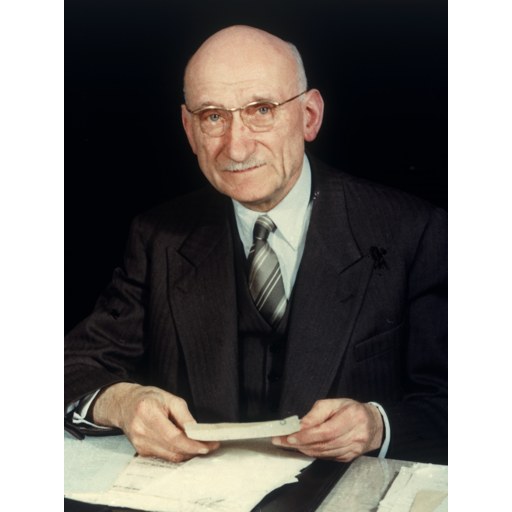
European Commission
License: CC BY 4.0
Robert Schuman
Venerable- Life Span
- 1886 - 1963 (age 77)
- Gender
- male
- Church
- Catholic
Places
Relics & Where to Venerate
Location unknown
The bodily remains of Robert Schuman are a first-class relic. Venerated at Église Saint-Quentin.
Roles & Family
Biography
Robert Schuman was born on 29 June 1886 in Clausen, a historic quarter of Luxembourg City in the Grand Duchy of Luxembourg. His father, Jean-Pierre Schuman, came from a Lorraine family at Evrange and had become a German national after the German Empire annexed Alsace-Lorraine in 1871. His mother, Eugénie Duren, was Luxembourgish. Because of his father's nationality, Schuman was born a German subject. He was educated at the Athénée de Luxembourg and then studied law at the universities of Bonn, Munich, Berlin, and Strasbourg. He established a legal practice in Metz, then under German rule, and took part in Catholic social and cultural associations in the region.
After the First World War, Alsace-Lorraine was restored to France and Schuman became a French citizen. In 1919 he was elected to the French Chamber of Deputies for the Moselle department, beginning a long career in Christian democratic and moderate parliamentary politics, with particular attention to the recovered eastern territories. Following the German invasion of France in 1940 he was arrested by the Gestapo, imprisoned, and later held under house arrest in the Palatinate. He escaped in 1942, reached the unoccupied zone, and remained in hiding in Resistance circles until the Liberation.
In the Fourth Republic he held high office as Minister of Finance and as President of the Council of Ministers (prime minister) from November 1947 to July 1948. As Minister of Foreign Affairs from 1948 to 1953 he issued, on 9 May 1950, the Schuman Declaration, prepared in close collaboration with Jean Monnet, proposing that Franco-German coal and steel production be placed under a common High Authority open to other European states. The plan led to the 1951 Treaty of Paris and the European Coal and Steel Community, a founding step of later European integration. He later served as President of the Common Assembly of that Community, forerunner of the European Parliament, from 1958 to 1960, and is counted among the principal Founding Fathers of the European Union.
Schuman never married and had no children. He was a devout Roman Catholic, formed by the Church's social teaching, who attended daily Mass and lived with personal austerity. From the interwar years he made his home at Scy-Chazelles near Metz, in a house now preserved as a museum. He died there on 4 September 1963 and was buried in the parish church of Saint-Quentin. The Diocese of Metz opened a cause for beatification in 1990. He was named a Servant of God, and on 19 June 2021 Pope Francis recognized his heroic virtues, conferring the title of Venerable. The date of the 1950 declaration is observed as Europe Day.