Rodolfo Acquaviva is a blessed of the Catholic Church (1550 - 1583). Rodolfo Acquaviva's feast day is celebrated on 25 July.
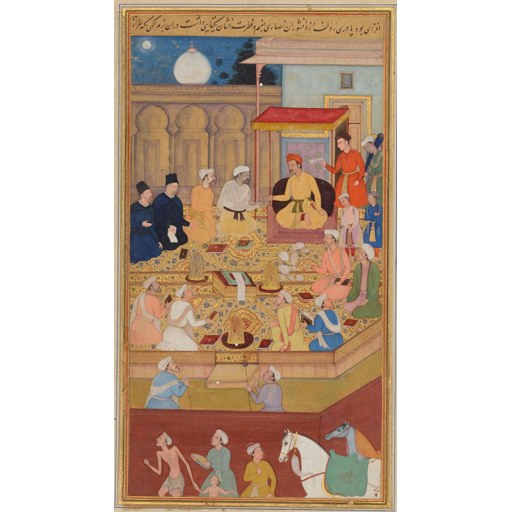
License: Public domain
Rodolfo Acquaviva
Blessed- Life Span
- 1550 - 1583 (age 33)
- Feast Day
- 25 July
- Gender
- male
- Church
- Catholic
Places
Roles & Family
Religious Information
Canonization
Biography
Rodolfo Acquaviva was born on 2 October 1550 at Atri in the Kingdom of Naples, into the prominent Acquaviva d'Aragona family, holders of the duchy of Atri in the Abruzzo. Despite the secular career that his rank made available, he entered the Society of Jesus in 1568. An uncle, Claudio Acquaviva, became the fifth Superior General of the order in 1581. Rodolfo completed Jesuit formation and studies at the Roman College and was ordained a priest. He asked for the Asian missions and, following the usual route of the Portuguese padroado, sailed from Lisbon and reached Goa in 1578.
Portuguese Goa was then the chief base of Jesuit work in India. After a short time there, Acquaviva was chosen in 1579–1580 to lead the first Jesuit embassy to the Mughal emperor Akbar, whose court was at Fatehpur Sikri. Akbar had asked for Christian priests after contacts with the Portuguese. Acquaviva’s companions were Antonio de Monserrate, later the author of an important narrative of the mission, and Francisco Henriques. The Jesuits reached court in 1580 and were received with honour. Akbar housed them, allowed a chapel, and admitted them to the religious debates of the Ibadat Khana.
Acquaviva learned Persian so that he could preach and dispute without an interpreter, and he took part in discussions with Muslim scholars and with the emperor. Akbar showed curiosity about the Gospel, the Trinity, and Christian images, and he permitted some instruction of members of the imperial household, including a brief attempt to teach his son Murad. He did not convert, and his own religious experiments moved toward the syncretic Din-i Ilahi rather than toward baptism. Jesuit letters from the court, including Acquaviva’s, record both hope and growing frustration. After about three years Acquaviva concluded that the mission was unlikely to produce the conversions the Society sought. He left the Mughal court and was back in Goa by the middle of 1583.
He was then made superior of the Jesuit residences in Salcete, a district south of the island of Goa where the Society, supported by Portuguese secular power, was engaged in an aggressive programme of conversion, church building, and the suppression of Hindu temples. Villages such as Cuncolim had repeatedly resisted. On 25 July 1583 Acquaviva went to Cuncolim with four fellow Jesuits—the priests Alfonso Pacheco, Pietro Berno, and Antonio Francisco, and the temporal coadjutor Francisco Aranha—together with a number of Goan Christians, in order to plant a cross and choose ground for a church. They were attacked and killed by villagers. Contemporary Jesuit and Portuguese reports describe the dead as martyrs slain in odium fidei; later historical writing has also stressed local defence of temples, land rights, and autonomy against colonial intrusion. The corpses were thrown into a well, later recovered, and taken to Goa.
A cult of the Cuncolim dead grew in the Society of Jesus and in Goa. After investigation of their lives and the circumstances of their death, Pope Leo XIII beatified Rodolfo Acquaviva and his four Jesuit companions on 30 April 1893. They have not been canonized. Acquaviva is therefore venerated as Blessed Rodolfo Acquaviva, one of the Martyrs of Cuncolim. Historians still use his correspondence from Fatehpur Sikri as evidence for the early Jesuit–Mughal encounter, while his death remains a focal point for competing memories of mission and resistance in sixteenth-century Goa.