Rufus and Zosimus is a saint of the Catholic Church. Rufus and Zosimus's feast day is celebrated on December 18.
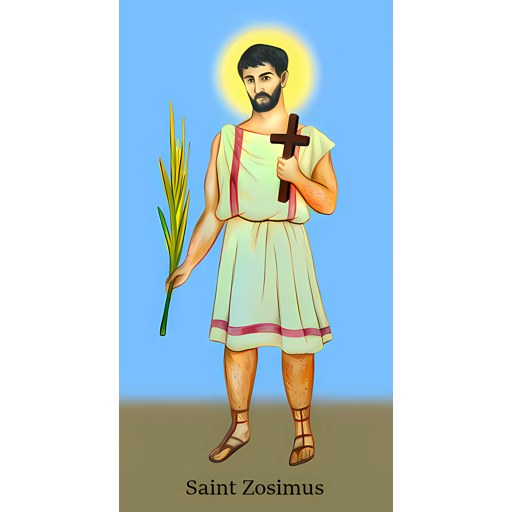
Robert444444 aka Philip K (Flickr)
License: CC BY-SA 4.0
Rufus and Zosimus
Saint- Feast Day
- December 18
- Gender
- male
- Church
- Catholic
Places
Roles & Family
Biography
Saints Rufus and Zosimus are a pair of early Christian martyrs whose names survive chiefly through a brief notice in the Letter to the Philippians of Polycarp of Smyrna and through later liturgical commemoration. Polycarp, writing in the second century to the church at Philippi in Macedonia, urged his readers to remain obedient to the word of righteousness and to practice endurance. He reminded them that they had seen such endurance with their own eyes in the blessed Ignatius and Zosimus and Rufus, as well as in others among their own community and in the apostle Paul. That sentence is the earliest and most secure evidence that two Christians named Zosimus and Rufus were known at Philippi as exemplary sufferers, associated in memory with Ignatius of Antioch. No contemporary text gives their parentage, place of birth, occupation, or the precise circumstances of their deaths, and no birth year can be established from any reliable source.
Subsequent Western tradition identified them as martyrs who died at Philippi. The Roman Martyrology, on 18 December, places the holy martyrs Rufus and Zosimus at Philippi in Macedonia and describes them as belonging to the company of disciples through whom the primitive Church was founded among Jews and Greeks, adding that their martyrdom is mentioned by Polycarp. Hagiographical writers of the early modern period, following this entry and the association with Ignatius, often presented Rufus and Zosimus as men connected with Antioch in Syria who accompanied the bishop when he was sent in chains from the East toward Rome under the emperor Trajan (reigned 98–117). In those later accounts they were condemned to be killed by wild beasts and suffered at Philippi about the time of Ignatius’s own martyrdom in Rome, a date conventionally given as 107. Ignatius’s authentic letters, written on that journey, do not name Rufus or Zosimus, and Polycarp does not specify where or how the two men died. Antiochene origin, condemnation to the beasts, and an exact year of death are therefore later reconstructions rather than facts established by second-century sources.
The historical setting that makes the tradition intelligible is the well-attested transfer of Ignatius from Antioch through Asia Minor and Macedonia toward Rome. Philippi lay on the Via Egnatia, the great road across Macedonia, and Christian communities there would have seen prisoners and escorts passing westward. Polycarp’s remark that the Philippians had seen Ignatius, Zosimus, and Rufus with their own eyes fits that geography: the two men may have been fellow prisoners or local Christians who suffered in the same period of pressure, and they were remembered in the Macedonian church alongside the more famous bishop of Antioch. Whether they died at Philippi itself, as the martyrology states, or elsewhere in the same era cannot be demonstrated from independent evidence. The archaeological site of ancient Philippi lies in present-day Greece. No inscription, early passion narrative, or relic tradition with a continuous history has been securely attached to them, and their burial place is unknown.
In the Latin Church their feast has remained 18 December. They were never popes or patriarchs, are not recorded as members of a later religious order, and have no documented spouses or children in the surviving literature. Standard catalogues of patronage do not assign them particular places, professions, or causes. Like most martyrs of the first generations, they were honored by local and then wider cult rather than by a formal papal canonization of the medieval or modern type. Because the dossier is so slight, a careful account must distinguish what Polycarp actually says—that Rufus and Zosimus were blessed examples of endurance known to the Philippians and named with Ignatius—from the fuller story of companions thrown to the beasts in a fixed year, which belongs to later hagiography. Within those limits they stand as two of the otherwise almost anonymous witnesses of the Trajanic age whose memory the church of Philippi and, later, the Roman Martyrology preserved.