Sabinus is a saint of the Catholic Church. Sabinus's feast day is celebrated on 7 December.
https://gettyimages.com/photos/sabinus
License: unknown
Sabinus
Saint- Feast Day
- 7 December
- Gender
- male
- Church
- Catholic
Roles & Family
Biography
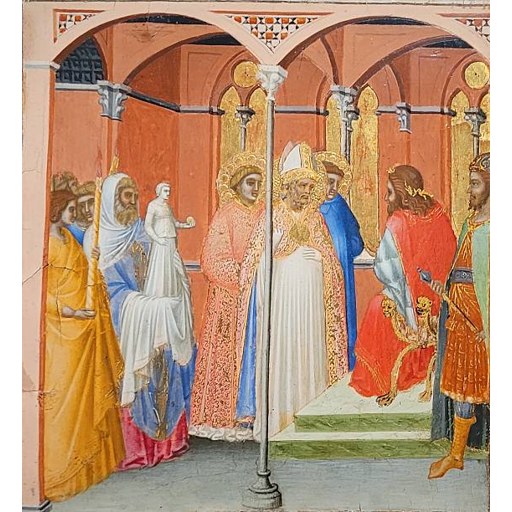
The name Sabinus is borne by several early Christian bishops and martyrs, and later tradition has not always kept them distinct. The figure most commonly intended in Western martyrologies under the simple designation Saint Sabinus is the bishop associated with Assisi and Spoleto. According to a passion narrative of late and uncertain date, he was bishop of Assisi when the Great Persecution struck Italy in the early fourth century. Arrested with the deacons Marcellus and Exuperantius, he was brought before a governor named Venustianus. The legend states that after he refused to offer sacrifice his hands were amputated, that he subsequently healed and converted the governor, and that he was at last beaten to death at Spoleto on the order of a higher imperial authority. Companions of his martyrdom are named in the same texts. None of these details can be confirmed from contemporary documents; the Acta are generally regarded by modern hagiographers as a pious compilation rather than a historical record.
What is more securely attested is the existence of an early cult. Spoleto honored a martyr Sabinus, and a church dedicated to him stood outside the city. The Hieronymian Martyrology and, later, the Roman Martyrology place his commemoration on 7 December, grouping him with fellow sufferers. Relics associated with his name were preserved and translated in the medieval period, which helped to spread the cult through Umbria and neighboring regions of central Italy. No reliable source records his year of birth, his native city, or the precise year of his death; the date 303, often printed in older calendars, is an inference from the traditional setting of the passion in the Diocletianic persecution, not a documented fact.
A different and historically better-documented Sabinus was bishop of Canusium (Canosa) in Apulia in the sixth century. Pope Gregory the Great refers to him, and later south-Italian tradition linked him with Benedict of Nursia and with the troubled years of Gothic and imperial conflict in Italy. His death is usually assigned to the middle of the sixth century. He is commemorated on 9 February and became a patron of Canosa and, in some traditions, of Bari; his relics were the object of medieval translations. Because both men were Italian bishops named Sabinus, popular legend and even some liturgical books have occasionally confused or merged them. Still other homonyms include Sabinus of Piacenza, a fourth-century bishop in correspondence with Ambrose of Milan, and various obscure martyrs listed in early martyrologies without recoverable biography.
No Sabinus of these early Italian cults was bishop of Rome or patriarch of an Eastern see. None can be shown from surviving evidence to have belonged to a later religious order, to have been married, or to have had children; arguments from the later discipline of clerical celibacy are not proof. Canonization, in the modern papal sense, does not apply: their cults belong to the age of local episcopal and popular recognition, later ratified by inclusion in martyrologies. Patronages attached to the name vary by locality and often belong to the Canosan rather than the Spoletan saint. In the absence of a more precise identification, the historian can only record that Sabinus denotes, in Catholic hagiography, primarily a martyr-bishop of the Spoleto tradition commemorated on 7 December, secondarily a sixth-century bishop of Canosa, and in any case a figure whose personal life remains almost entirely beyond verification.