Sacerdos is a saint of the Catholic Church (d. 552). Sacerdos's feast day is celebrated on 12 September.
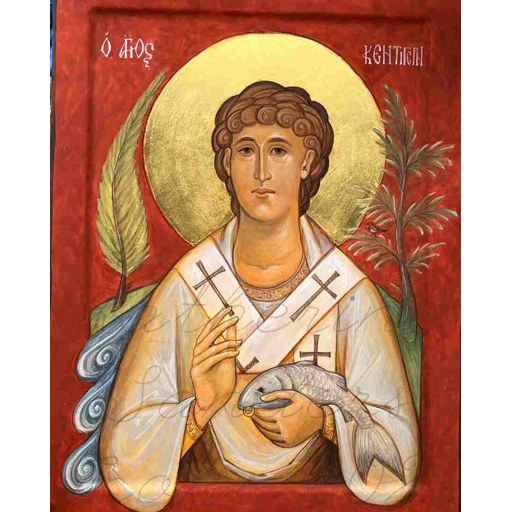
https://katherinesandersicons.com/
License: unknown
Sacerdos
Saint- Life Span
- d. 552
- Feast Day
- 12 September
- Gender
- male
- Church
- Catholic
Places
Roles & Family
Biography
Saint Sacerdos, also attested under the forms Sardot and Serdot, was bishop of Lyon in the middle of the sixth century, in the early Merovingian decades when the old Gallo-Roman metropolitan sees were adapting to Frankish royal power. Lyon had long been the leading church of the Three Gauls, and its bishop exercised metropolitan authority over a wide region of eastern and southeastern Gaul. Contemporary narrative sources for Sacerdos himself are limited. He belongs to the generation immediately before the copious historical writing of Gregory of Tours, who is far more informative about Sacerdos’s nephew and successor Nicetius than about Sacerdos. Later local tradition of the church of Lyon presents him as a native of the city and as a member of its senatorial Christian aristocracy, but no surviving sixth-century document records an exact year of birth. Figures such as 487 that appear in some modern compilations are retrospective estimates, not documented dates, and cannot be treated as verified.
Sacerdos occupied the see from about 544 until 552. In 549 he took part in the Fifth Council of Orléans, assembled with the support of King Childebert I. That council legislated on episcopal elections, asylum, the management of church property, and the exclusion of heretical clergy, and it reflects the working alliance between the Frankish monarchy and the Gallic episcopate. As bishop of Lyon he would have presided over a large urban Christian community, with its cathedral, baptistery, suburban martyr basilicas, and charitable houses, and he would have confirmed and ordained in the suffragan dioceses of his province. The most securely attested personal fact about him is kinship: Nicetius, later venerated as Saint Nizier of Lyon, was the son of Sacerdos’s sister and was chosen to succeed him. Uncle-to-nephew succession was characteristic of several aristocratic Gallic churches in the fifth and sixth centuries, in which episcopal office circulated within leading families. No reliable source names a wife or children of Sacerdos; whether he had been married before consecration, a practice not yet uniformly abolished in Gaul, remains unknown. He held no monastic affiliation in the later sense of a named religious order, and he was neither Bishop of Rome nor a patriarch of an Eastern see.
Traditional accounts state that Childebert I called Sacerdos to Paris and that the bishop died there on 11 September 552. His remains were then returned to Lyon and buried in the church of the Holy Apostles, a prominent extra-cathedral church that subsequently became known as Saint-Nizier because Nicetius was also interred there and attracted a stronger cult. Sacerdos’s own liturgical memory was kept on 12 September, the date under which he appears in the Roman Martyrology. He was venerated as a saint by local acclamation in the manner of the early medieval Church; there was no later papal bull of canonization or beatification, and he acquired no widely known specialized patronages of trades, illnesses, or distant places. His historical profile is therefore that of a metropolitan bishop of senatorial background, active in conciliar and royal circles, whose cult stayed tied to Lyon.
Care is required because the Latin name Sacerdos, meaning priest, was borne by more than one holy person, and these homonyms should not be conflated. Saint Sacerdos of Limoges belongs to a later period, around the end of the seventh century and the beginning of the eighth, and is connected with the Limousin rather than with Lyon; his feast is kept in May. A further, more poorly documented Sacerdos is associated with Saguntum in Hispania. These figures are distinct from the Lyon bishop who died in 552. For the Lyon Sacerdos, the verifiable core remains modest: metropolitan of Lyon in the 540s, participant in the Council of Orléans of 549, uncle of Saint Nicetius, death in 552, burial at the church of the Apostles in Lyon, and a feast on 12 September. Claims that go beyond this core, including a precise birth year or a detailed childhood, rest on later tradition rather than on contemporary evidence.