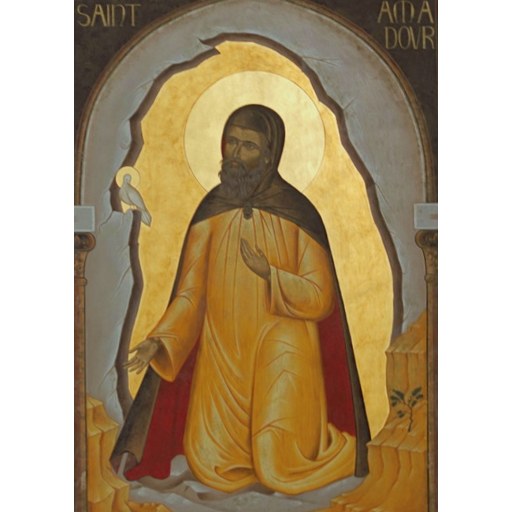
Saint Amadour is a saint of the Catholic Church. Saint Amadour's feast day is celebrated on August 20.
Octave 444
License: CC BY-SA 4.0
Saint Amadour
Saint- Feast Day
- August 20
- Gender
- male
- Church
- Catholic
Places
Roles & Family
Biography
Saint Amadour (also rendered Amator in Latin) is the legendary hermit whose name is inseparable from the cliff-side pilgrimage sanctuary of Rocamadour in historic Quercy, now in the Lot department of southwestern France. No contemporary documentation of his life survives. He is absent from the early martyrologies, and no vita that can be dated before the twelfth century is known. The figure of Amadour becomes visible in the written record only when the shrine of Our Lady of Rocamadour rose, with striking speed, to rank among the great Marian pilgrimages of medieval Western Europe. The place-name itself—Rocamadour, from medieval forms such as Rocamador and Rupes Amatoris, the rock of Amadour—was explained by local clergy and pilgrims as commemorating a holy man who had lived and died in a cave in the near-vertical limestone face above the Alzou canyon.
In 1166, according to the sanctuary’s own tradition and to the twelfth-century miracle literature connected with Rocamadour, an intact body was discovered in a sepulchre at the site. The remains were identified as those of Saint Amadour, presented as an ancient hermit, and were exposed for veneration. This inventio of relics coincided with the shrine’s international celebrity, which drew penitents, nobles, and royalty. The body attributed to Amadour was kept in a chapel that still bears his name, among the cluster of sanctuaries clinging to the rock between the castle above and the village below. In 1562, during the French Wars of Religion, Huguenot forces sacked Rocamadour; later accounts report that the relics of Amadour were desecrated or destroyed. Later restorations of the religious city did not recover the original remains.
From the later Middle Ages, especially in the fourteenth and fifteenth centuries, a more elaborate legend identified Amadour with Zacchaeus, the chief tax collector of Jericho who, in the Gospel of Luke, climbed a sycamore in order to see Jesus and then received him in his house. In that story Zacchaeus, sometimes said to have married Saint Veronica (the woman who, in extra-biblical tradition, wiped the face of Christ on the way to Calvary), left the Holy Land after the Passion, reached Gaul—often said to have landed at Soulac on the Atlantic coast—preached, and at last withdrew as a hermit to the rock thereafter called Rocamadour, where he died. Other versions made Amadour a servant or companion of the Virgin Mary. Historians treat these identifications as pious constructions meant to give the shrine apostolic or evangelical antiquity; they are not supported by independent ancient sources. Whether a real local hermit ever underlay the name, or whether Amadour was largely fashioned in the twelfth century to explain the toponym and to authenticate the pilgrimage, cannot be settled from the surviving evidence.
No historically verified year of birth or death, place of birth, or papal act of canonization can be cited. Amadour was not a pope or a patriarch and is not known to have belonged to a later religious order; tradition describes him only as a hermit. Statements that he was married to Veronica, or that he had children, belong solely to the late legendary cycle and cannot be treated as fact. A local feast has customarily been observed on 20 August, a date associated in some accounts with the twelfth-century discovery of the body. Devotion to Saint Amadour has remained closely bound to the sanctuary of Rocamadour and to the cult of Our Lady there, rather than developing into a widely recognized patronage of particular trades, illnesses, or nations.