Saint Amandus is a saint of the Catholic Church (584 - 679). Saint Amandus's feast day is celebrated on 6 February. Saint Amandus is the patron saint of Flanders;Belgium;Ghent;brewers;innkeepers;wine merchants;vintners;bartenders;merchants;against hernia;against paralysis;against rheumatism;against spasms;against gout;against stiffness;against stomach trouble;against vomiting.
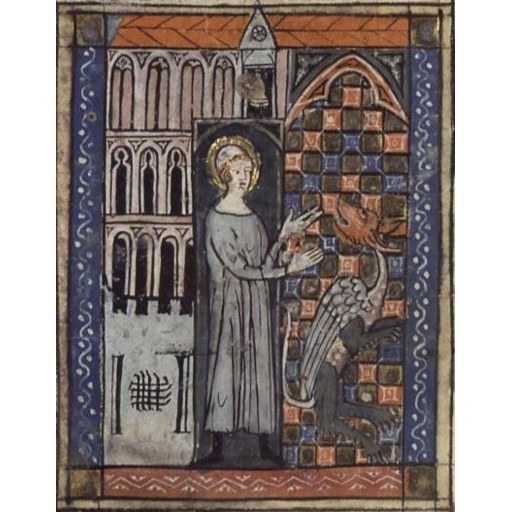
Richard de Montbaston et collaborateurs
License: Public domain
Saint Amandus
Saint- Life Span
- 584 - 679 (age 95)
- Feast Day
- 6 February
- Gender
- male
- Church
- Catholic
Places
Roles & Family
Religious Information
Patronage
Flanders;Belgium;Ghent;brewers;innkeepers;wine merchants;vintners;bartenders;merchants;against hernia;against paralysis;against rheumatism;against spasms;against gout;against stiffness;against stomach trouble;against vomiting
Biography
Saint Amandus, also known as Amand of Maastricht or Amand of Elnone, was a seventh-century Frankish missionary bishop and monastic founder who came to be called the Apostle of Flanders. He was born in the late sixth century, traditionally about 584, into a noble family in Lower Poitou in western Gaul, in the region associated with Nantes in what is now France. Against the wishes of his family he entered religious life while still young. Early accounts describe a period as a hermit on the island of Yeu off the Atlantic coast, followed by many years in a cell near the cathedral of Bourges under Bishop Austregisilus, where he was ordained a priest. A pilgrimage to Rome is said to have confirmed his vocation to itinerant preaching among peoples who were still largely pagan.
From about the 620s he worked as a missionary in the Scheldt valley and the region of Ghent, in territory that corresponds to much of modern Belgium and northern France. Contemporary and near-contemporary sources, including a vita attributed to his disciple Baudemundus, describe initial hostility, including beatings and expulsion, followed by gradual success with the support of Merovingian royal authority, especially King Dagobert I. Amandus founded or helped to found a series of monasteries that became centers of Christianization and of Benedictine observance. The most important of these was Elnone on the Scarpe, later the abbey and town of Saint-Amand-les-Eaux. He is also associated with the monastery of Blandinium (Saint Peter's Abbey) at Ghent and with other houses in the region, including connections with Nivelles. The hagiographical tradition further credits him with missions among the Basques and along the Danube; those episodes are less securely documented than his work in Flanders and northern Gaul.
Around the middle of the seventh century Amandus was appointed bishop of the see of Tongeren-Maastricht. He held the office only a short time before resigning it, preferring missionary preaching and monastic foundation to settled diocesan administration. He remained in contact with other leading churchmen of the Frankish kingdoms, including Saint Eligius of Noyon, and is remembered in tradition as having baptized Saint Bavo of Ghent. In his last years he retired to the abbey of Elnone, which he had established. He died there on 6 February, in 675 or, according to the date more commonly given in later tradition, 679. His tomb at Elnone became a focus of pilgrimage, and the abbey that bore his name was a major religious and intellectual center in the Carolingian period.
Amandus was venerated as a saint from an early date; his cult belongs to the era before formal papal canonization procedures. His feast is kept on 6 February. He is regarded as a principal evangelizer of what is now Belgium and northern France and is invoked as patron of Flanders, of brewers, innkeepers, wine merchants and related trades, and of those suffering from hernia, paralysis, rheumatism, spasms, gout, stiffness, and various stomach ailments.