Saint Antide is a saint of the Catholic Church (d. 411). Saint Antide's feast day is celebrated on 25 June.
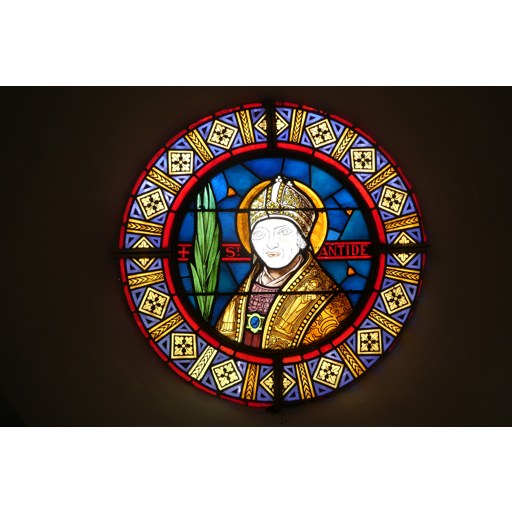
Pmau
License: CC BY-SA 4.0
Saint Antide
Saint- Life Span
- d. 411
- Feast Day
- 25 June
- Gender
- male
- Church
- Catholic
Places
Roles & Family
Biography
Saint Antide, also known in Latin as Antidius and in later French usage as Antide de Besançon, was a bishop of the church of Vesontio (Besançon) in eastern Gaul, in the region that later became Franche-Comté, during the early fifth century. No contemporary chronicle or inscription records his birth, parentage, or the year in which he became bishop, and the outline of his life depends on later medieval hagiography and on the diocesan tradition of Besançon. A vita composed centuries after the events it recounts presents him as a native of that region and as a priest who succeeded to the episcopal see in the line of earlier Besançon bishops such as Desideratus. The Roman Martyrology commemorates him on 25 June as bishop and martyr of Besançon, slain by the Vandals for the Christian faith. That liturgical notice, rather than any fifth-century document, is the principal ancient witness to his cult.
The setting of his episcopate was the collapse of secure Roman government in Gaul. In late 406 a coalition of Vandals, Suebi, and Alans crossed the Rhine and moved through the Gallic provinces. Later tradition identifies the Vandals as the agents of Antide’s death and assigns the martyrdom to 411, a conventional date tied to that invasion rather than to a dated contemporary report. According to the legend, as hostile forces threatened Besançon the bishop withdrew for a time and then returned to care for his people; he was seized and put to death, in some versions while celebrating the liturgy, and was said to have been beheaded, with his body thrown into a river (the Doubs or a nearby stream) and afterward recovered by the faithful. Some local accounts place the killing at or near Ruffey-le-Château in the Doubs, but the martyrology itself simply locates the martyr at Besançon in Gaul, and the precise site cannot be confirmed from independent historical evidence.
Antide was a diocesan bishop, not a member of a religious order, and he held neither the papacy nor a patriarchal see. Nothing reliable is recorded about a wife or children; the surviving notices treat him in the conventional pattern of a late-antique Gallic pastor and martyr. His cult remained essentially local. Relics associated with him were kept and venerated at Besançon, and his name entered the calendar of that church and, through the martyrology, the wider Latin liturgy. He is not among the principal patrons of the city—Saints Ferreolus and Ferrutio occupy that place in Besançon tradition—but he was remembered as one of the early bishops who suffered in the invasions of the fifth century.
Because the written lives are late and legendary, many details that later retellings supply cannot be verified: the year of his birth, his exact birthplace, the day-to-day character of his episcopate, the precise circumstances of his arrest, and the original place of burial all remain uncertain. What can be stated with caution is that the church of Besançon preserved the memory of a bishop named Antidius, honored as a martyr in connection with the early fifth-century invasions of Gaul; that his feast was kept on 25 June; and that he belongs to the large company of poorly documented but liturgically remembered bishop-martyrs of late antique Gaul, whose historical silhouette is faint but whose commemoration is old and consistent in the regional tradition.