Saint Aubert is a saint of the Catholic Church (d. 720). Saint Aubert's feast day is celebrated on 10 September.
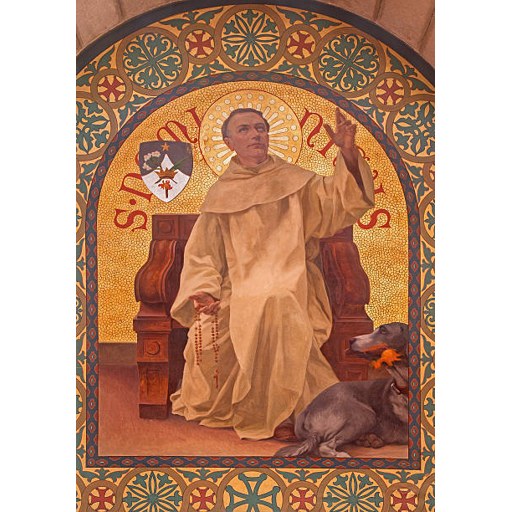
https://istockphoto.com/photos/saint-painting
License: unknown
Saint Aubert
Saint- Life Span
- d. 720
- Feast Day
- 10 September
- Gender
- male
- Church
- Catholic
Places
Roles & Family
Biography
Saint Aubert (also Autbert or Aubertus) is the name under which later tradition remembers the Frankish bishop of Avranches who, in the early eighth century, founded the oratory on the tidal island then called Mont Tombe, the sanctuary that became Mont-Saint-Michel. Almost nothing about his family, birthplace, or early career can be verified from contemporary evidence. No reliable source records a year of birth, and later notices that treat him simply as bishop of Avranches when the foundation took place should not be read as filling that gap. He belongs to the church of Neustria in the generation after the Merovingian heyday, when cults of the Archangel Michael were spreading in the Latin West. The name Aubert/Autbert was borne by more than one early medieval bishop, notably Autbert of Cambrai in the seventh century; the Avranches founder is the figure usually meant by “Saint Aubert” in connection with the mount.
The principal narrative of his life is not a contemporary vita but the Revelatio ecclesiae sancti Michaelis in monte Tumba, a Latin account generally dated to the ninth century. According to that text, in 708 the Archangel Michael appeared to Aubert in a dream and ordered him to build a church in the archangel’s honour on Mont Tombe, off the coast of what is now Normandy. Aubert disregarded the first two visions. On the third, the archangel is said to have pressed a finger into the bishop’s skull and left a hole as a tangible sign. Aubert then caused an oratory to be raised on the rock. Traditional chronology places the dedication on 16 October 709. The same legend has him send envoys to the older Michaelic shrine at Monte Gargano in Italy to obtain a relic (a fragment associated with the Gargano cult) and to staff the new church with a small body of clerks, often numbered as twelve. These details are hagiographical and cannot be confirmed independently, but they preserve a historical kernel: a church dedicated to Saint Michael was established on the island in the early eighth century, in conscious relation to the Italian cult.
Aubert’s death is conventionally placed in 720. That year is traditional rather than documented by a contemporary obituary, and some notices are less precise. As bishop of Avranches he is presumed to have died in or near his see; his later cult is centred both on the mount and on Avranches. Over the following centuries the island sanctuary grew from a modest oratory into the great Benedictine abbey of Mont-Saint-Michel (the Benedictine community itself dates from a later Norman refoundation, not from Aubert’s own lifetime). A skull identified as his, pierced by a hole corresponding to the legend of the archangel’s finger, has long been venerated in Avranches and is now kept in the Basilica of Saint-Gervais. Modern examination of the relic has noted that the opening is consistent with a healed trepanation, which may have generated or reinforced the miracle story; the identification of the bone as Aubert’s remains a matter of cult tradition.
Aubert was never the object of a formal papal canonization of the later medieval or modern type. His sainthood belongs to the age of local episcopal cult and popular veneration, subsequently received in the wider Latin church. His feast is kept on 10 September in a number of calendars. He did not hold the see of Rome or any patriarchal office, and no reliable source assigns him a religious order, a spouse, or children. Formal patronages of places, professions, or causes are not securely listed in the historical record used here, though he is inseparably linked in memory with the foundation of Mont-Saint-Michel and with the church of Avranches. The limits of the dossier should be stated plainly: beyond the episcopal title, the early-eighth-century Michaelic foundation on Mont Tombe, the later relic cult, and the conventional date of death, the biography of Saint Aubert remains the product of ninth-century and subsequent hagiography rather than of contemporary chronicle.