Saint Barbara is a saint of the Pre-Schism (Universal) Church. Saint Barbara's feast day is celebrated on 4 December. Saint Barbara is the patron saint of artillerymen;miners;architects;builders;stonemasons;firefighters;military engineers;armourers;explosives workers;ammunition workers;mathematicians;prisoners;sailors;tunnellers;foundry workers;fortifications;against lightning;against fire;against sudden death;those in danger of dying unprepared.
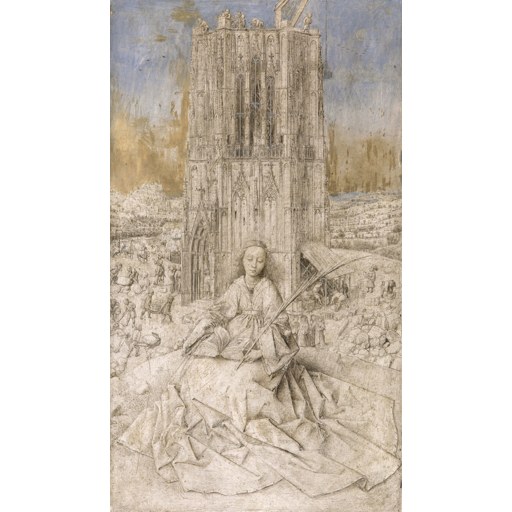
Jan van Eyck
License: CC0
Saint Barbara
Saint- Feast Day
- 4 December
- Gender
- female
- Church
- Pre-Schism (Universal)
Places


Roles & Family
Patronage
artillerymen;miners;architects;builders;stonemasons;firefighters;military engineers;armourers;explosives workers;ammunition workers;mathematicians;prisoners;sailors;tunnellers;foundry workers;fortifications;against lightning;against fire;against sudden death;those in danger of dying unprepared
Biography
Saint Barbara is among the most widely venerated virgin martyrs of Christian tradition, yet almost nothing about her can be established by contemporary historical evidence. No writer of the third or fourth century mentions her, and the earliest known accounts of her passion belong to the seventh century. Later Greek, Syriac, and Latin recensions, together with the influential thirteenth-century Golden Legend of Jacobus de Voragine, present a story conventionally placed in the Roman East during the persecutions of the late third or early fourth century, often associated with the year 306 and with the emperor Maximian. Even these legendary sources do not agree on geography: Nicomedia in Bithynia, Heliopolis in Phoenicia (Baalbek), towns in Egypt, and, in some Western versions, Tuscany have all been named as the scene of her life and death. Because the Acts are late, internally inconsistent, and unsupported by early cult, modern historians treat Barbara as a figure of pious legend rather than a documented person. In 1969 her feast was omitted from the General Roman Calendar for that reason, though her name remains in the Roman Martyrology and her veneration continues in the Eastern Orthodox Church, the Oriental Orthodox churches, and in numerous Catholic local calendars as well as military and mining traditions.
The received narrative describes her as the only daughter of a rich pagan, Dioscorus, who, anxious to preserve her from unwanted suitors and from Christian teaching, confined her in a tower. Isolated there, she is said to have studied the order of creation, to have rejected the gods of her father, and to have accepted baptism, in some tellings from a priest admitted in secret. When Dioscorus sought to give her in marriage, she refused, declaring herself a Christian. During a journey of her father’s, a bath-house or tower-chamber was being finished according to his instructions with two windows; Barbara ordered a third window opened, as a confession of the Trinity, and traced a cross in the stone. Upon his return Dioscorus understood the meaning, drew his sword, and would have killed her at once. A cleft in the rock, the legend says, opened to receive her; a shepherd betrayed her hiding place, and she was dragged back.
Brought before the prefect Martinianus, she was subjected to prolonged torture: scourging, raking of the flesh, burning with lamps or torches, and public humiliation. Hagiographers relate that her wounds were healed overnight, that the torches were extinguished, and that she was comforted in prison by visions. Condemned at last to beheading, she was executed by her own father on a mountain. As Dioscorus descended, lightning struck him and fire consumed his body. This thunderbolt became the germ of her later role as protector against lightning, explosion, and sudden, unprepared death. A pious man named Valentinus is sometimes said to have buried her remains. No historically secure tomb has been identified; relics attributed to her have been shown at the Coptic Church of Saint Barbara in Old Cairo, at Kiev, and at other shrines.
From the high Middle Ages her cult spread rapidly. She was counted among the Fourteen Holy Helpers, a group of saints invoked especially against sudden death and epidemic. Artillerymen, armourers, and makers of gunpowder and fireworks claimed her because of the lightning that destroyed her executioner; miners, tunnellers, and all who worked underground invoked her because she had been shut in a tower and because of the rock that opened for her. Architects, builders, stonemasons, and military engineers associated themselves with the tower and its three windows. Firefighters, prisoners, mathematicians, sailors, foundry workers, and those in danger of fire or of dying without the sacraments likewise took her as patron. In art she is recognized by the tower (often with three windows), the palm of martyrdom, a chalice and host signifying her desire to receive the Eucharist before death, and sometimes by cannon or a bolt of lightning.
Her principal feast is 4 December in both the Roman Martyrology and the Byzantine liturgical calendar. In parts of Europe and the Middle East the day is marked by blessing of wheat, branches, or fruit, by the beginning of Advent customs, and by professional observances among gunners and miners. The city of Santa Barbara in California and many churches, forts, and powder magazines bear her name. The endurance of her cult, long after critical scholarship had dismantled the historicity of the written Acts, rests on the moral outline of the legend: a young woman who chose Christian faith against the violence of father and state, and who was thereafter invoked by people whose work or fortune exposed them to sudden destruction.