Saint Blaise is a saint of the Catholic Church (d. 316). Saint Blaise's feast day is celebrated on 3 February. Saint Blaise is the patron saint of throat illnesses;wild animals;wool combers;wool workers;physicians;veterinarians;Dubrovnik;Maratea;cattle;whooping cough;builders;stone cutters;animals;those at risk of choking.
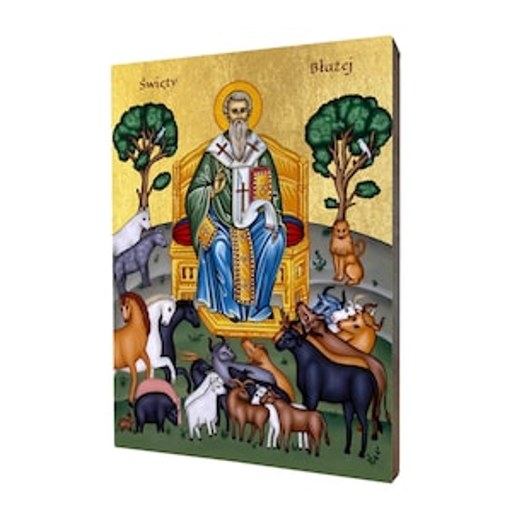
https://www.etsy.com/market/saint_blaise
License: unknown
Saint Blaise
Saint- Life Span
- d. 316
- Feast Day
- 3 February
- Gender
- male
- Church
- Catholic
Places
Roles & Family
Patronage
throat illnesses;wild animals;wool combers;wool workers;physicians;veterinarians;Dubrovnik;Maratea;cattle;whooping cough;builders;stone cutters;animals;those at risk of choking
Biography
Saint Blaise, known in Latin as Blasius and in other languages as Blaize, Biagio, or Vlaho, is venerated as a bishop and martyr of the early fourth century associated with the city of Sebastea (present-day Sivas in Turkey) in historical Armenia, then within the eastern Roman Empire. Almost nothing about his life can be confirmed from contemporary documents. He does not appear in the earliest datable martyr acts, and the narratives that describe him in detail belong to later Greek and Latin hagiography, which scholars generally treat as legendary in their specific episodes. A bishop-martyr of this name was nonetheless commemorated at Sebastea from a relatively early date, and his name entered both Eastern and Western martyrologies. Tradition identifies him as a physician who was chosen bishop of Sebastea and who suffered in the persecutions of the early fourth century. His death is customarily placed in 316, in the time of the emperor Licinius, though some accounts associate him instead with the earlier Diocletianic persecution.
According to the received legend, when persecution intensified Blaise withdrew from the city into the wilderness of Mount Argeus, where he lived in a cave. Wild animals were said to come to him unbidden to be healed, a motif that later made him a patron of animals and of those who care for them. Hunters in the service of the local governor, named Agricolaus in the texts, discovered the cave, captured the bishop, and brought him back to Sebastea. On the journey he encountered a woman whose child was dying with a fishbone lodged in the throat; Blaise prayed and the bone was dislodged, an incident that became the origin of his principal patronage and of the later Blessing of the Throats. Another story tells that a wolf carried off a pig belonging to a poor widow; at Blaise's command the wolf restored the animal, and the woman later brought food and candles to him in prison.
Refusing to offer sacrifice to the imperial gods, Blaise was subjected to torture. The passio describes him as being torn with iron combs of the kind used in the wool trade, a detail that in the Middle Ages linked him with wool-combers and related crafts. He was finally beheaded. The same legendary cycle includes the martyrdom of seven women who collected drops of his blood, and other secondary episodes typical of later passion literature. Because these narratives were composed or expanded well after the events they purport to describe, they cannot be used as a straightforward historical record; they do, however, explain the iconography and the range of patronages attached to the saint.
The cult of Saint Blaise spread through the Christian East and, from the early Middle Ages, across Latin Europe. His principal feast in the Roman calendar falls on 3 February; many Eastern churches keep it on 11 February. In the later Middle Ages he was numbered among the Fourteen Holy Helpers, saints invoked against particular diseases, and he was the helper against affections of the throat. The Blessing of Throats, in which a priest holds two crossed candles against the throat of the faithful and recites a prayer in Blaise's name, remains a distinctive Catholic sacramental associated with his feast. He is the patron saint of the city of Dubrovnik (the medieval republic of Ragusa), which has long claimed a relic of his head and celebrates him as a civic protector; Maratea in Basilicata likewise claims his relics and honors him as its patron. Other traditional patronages include physicians, veterinarians, wild animals, cattle, wool-combers and workers in the wool industry, builders and stone-cutters, and those suffering from whooping cough or other throat complaints.
Relics attributed to Saint Blaise were widely distributed in the medieval period, and churches dedicated to him are found from the Balkans to the British Isles. In art he is commonly shown as a bishop with mitre and crozier, holding two crossed candles or the iron wool-combs of his torture, sometimes with a pig at his feet in allusion to the widow's animal. Historical caution is required: the man behind the legend, if a single historical bishop-martyr of Sebastea is the source of the cult, remains largely inaccessible. What can be said with confidence is that by the early Middle Ages Saint Blaise had become one of the most widely invoked holy helpers in both East and West, and that his name, feast, and characteristic blessing have continued in Christian practice down to the present.