Saint Blane is a saint of the Catholic Church (d. 590). Saint Blane's feast day is celebrated on 10 August. Saint Blane is the patron saint of Dunblane;Isle of Bute.
Akerbeltz
License: CC BY-SA 3.0
Saint Blane
Saint- Life Span
- d. 590
- Feast Day
- 10 August
- Gender
- male
- Church
- Catholic
Places
Roles & Family
Patronage
Dunblane;Isle of Bute
Biography
Saint Blane, also known as Blaan or Bláán, was a bishop and confessor of the early medieval Celtic Church who flourished in the sixth century. According to traditional accounts preserved in later medieval sources, including the Aberdeen Breviary, he was born on the Isle of Bute in the Firth of Clyde, in what is now Scotland. He is described as the nephew of Saint Cathan (or Catan), a holy man who had established a religious cell on Bute; Blane's mother, sometimes named Ertha or Erca, was Cathan's sister. One later legend relates that Blane's mother was cast adrift in a small boat after conceiving a child and came ashore in Ireland, where Blane was born or raised for a time, but the more commonly repeated tradition simply places his birth on Bute itself. Precise dates for his birth are not recorded in any contemporary source.
As a youth Blane was sent to Ireland for his education, a common practice among the clergy of Dál Riata and neighboring British kingdoms. He is said to have studied for seven years under Saint Comgall at Bangor and under Saint Cainnech (Kenneth) of Aghaboe. After completing his formation he returned to Scotland, where he entered the monastic life and was associated with the church of Kingarth (Ceann Garadh) on the southern part of Bute, a site already connected with his uncle Cathan. In time Blane was raised to the episcopate and is remembered as bishop of Kingarth. Later medieval writers, notably the compilers of the Aberdeen Breviary, added that he undertook a pilgrimage to Rome and received episcopal consecration there, though this Roman journey is not attested in early sources and may reflect a later desire to link the Scottish saint with papal authority.
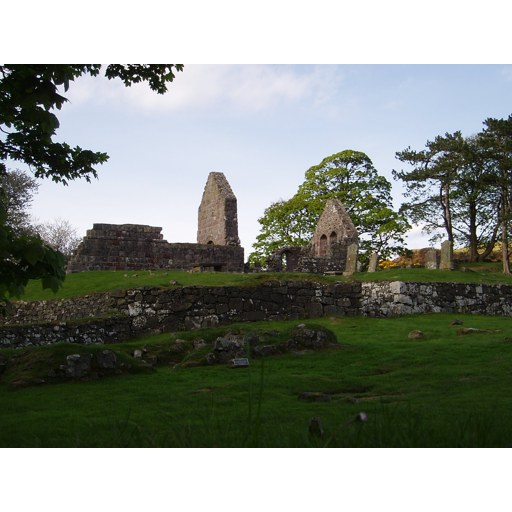
Blane's cult was closely tied to Bute and to the mainland church of Dunblane in Strathearn, whose Gaelic name, Dùn Bhlàthain, means the fort of Blane. Whether Blane himself founded a church at Dunblane or whether his relics or dedication were later transferred there is uncertain; by the twelfth century Dunblane had become the seat of a diocese whose cathedral was dedicated to him. On Bute the early Christian site at Kingarth remained a focus of his memory. The ruined twelfth-century church of St Blane at Kingarth stands on an earlier ecclesiastical enclosure and is accompanied by two burial grounds, traditionally one for men and one for women. Hagiographical tradition ascribes various miracles to the saint, including the kindling of fire and other wonders typical of Celtic vitae, but these stories survive only in late and legendary form.
Blane is generally said to have died about the year 590 and to have been buried on his native island of Bute, at Kingarth. His feast is kept on 10 August in Scottish calendars and in the Aberdeen Breviary. He was venerated as a confessor rather than a martyr, and his cult belongs to the pre-congregation period of the Church; he was never the subject of a formal papal canonization in the later medieval sense. Dunblane Cathedral and the church at Kingarth remain the principal monuments associated with his name, and he is regarded as a patron of Dunblane and of the Isle of Bute.