Saint Christina is a saint of the Catholic Church. Saint Christina's feast day is celebrated on 24 July. Saint Christina is the patron saint of Bolsena;Palermo;millers;archers.
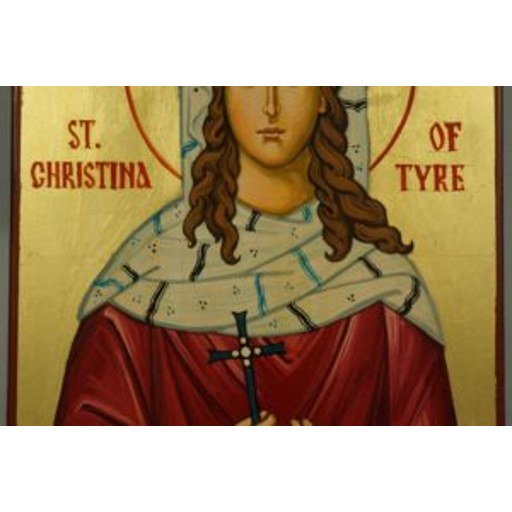
https://www.blessedmart.com/shop/hand-painted-icons/female-saints-icons/saint-christina-of-tyre/
License: unknown
Saint Christina
Saint- Feast Day
- 24 July
- Gender
- female
- Church
- Catholic
Places
Roles & Family
Patronage
Bolsena;Palermo;millers;archers
Biography
Saint Christina, commonly identified in the Latin West as Christina of Bolsena and in Greek sources as Christina of Tyre, is a Christian virgin martyr whose public cult is ancient but whose biography cannot be reconstructed from contemporary evidence. No inscription, imperial record, or eyewitness account of her life survives. The so-called Acts of Christina are late, densely miraculous, and historically untrustworthy; modern hagiographers therefore treat her as a figure of legend and liturgical memory rather than as a person whose dates and career can be fixed. Western martyrologies place her passion at Bolsena in central Italy (ancient Tuscia, on Lake Bolsena), while Byzantine synaxaria associate a saint of the same name with Tyre in Phoenicia. Many scholars regard these as two localizations of a single legendary cycle rather than two independently documented martyrs. Because of this uncertainty, neither a birth year nor a historically verified year of death can be given; tradition merely situates her in the age of the Roman persecutions, often the third century.
The traditional narrative, widely circulated in medieval legendaries, presents Christina as the daughter of a wealthy pagan magistrate, frequently named Urbanus, who kept household idols of gold and silver. Converted to Christianity in adolescence, she smashed the idols and distributed the fragments to the poor. Her father and, after his death, successive judges are said to have subjected her to a long series of tortures: scourging, iron hooks, confinement, a furnace or burning, and drowning with a millstone in a lake—identified in the Italian tradition with Lake Bolsena. The legend claims that she was repeatedly preserved by miracle, converted onlookers, and was finally killed by arrows or by a spear or dagger through the heart. None of these episodes can be confirmed outside the hagiographical texts. She is commemorated as a virgin, and there is no tradition of a husband or children.
Devotion at Bolsena is the most tangible historical footprint of the cult. A basilica dedicated to Santa Cristina stands in connection with catacombs, and relics attributed to her have long been venerated there; this shrine is the traditional place of burial. In 1263 a Eucharistic miracle was reported during a Mass in that church: a doubting priest, celebrating at the altar of Santa Cristina, is said to have seen the host bleed onto the corporal. The event was linked to the later universal feast of Corpus Christi and greatly increased the fame of the Bolsena sanctuary. In the East, Christina of Tyre appears in the Byzantine liturgical books. The Roman Martyrology commemorates Saint Christina, virgin and martyr, at Bolsena on 24 July, a date shared by many Eastern calendars. She belongs to the pre-congregation period of the cult of saints and was never the object of a formal papal canonization of the later medieval or modern type.
In later popular devotion she became a patron of Bolsena itself and was numbered among the patron saints of Palermo, together with other early virgin martyrs of Sicilian and Italian cult. The millstone of the drowning episode and the arrows of her death suggested, in folk piety, patronage of millers and of archers. Iconography typically shows a young woman with a millstone, arrows, or a palm of martyrdom. Historians can affirm the antiquity and geographic spread of her feast, the reality of the Bolsena shrine, and the literary diffusion of her legend in both Latin and Greek Christianity; they cannot affirm the biographical particulars as fact. The name Christina was borne by several other holy women in later centuries—among them Christina the Astonishing in the Low Countries and Christina of Markyate in England—who must not be confused with this early martyr.