Saint Christopher is a saint of the Catholic Church. Saint Christopher's feast day is celebrated on 25 July (Western Christianity); 9 May (Eastern Christianity). Saint Christopher is the patron saint of travelers;motorists;sailors;mariners;ferrymen;porters;transportation workers;truck drivers;bachelors;gardeners;fruit dealers;bookbinders;athletes;against lightning;against storms;against hailstorms;against floods;against pestilence;against plague;against sudden death;epilepsy;toothache;holy death;Havana;Saint Kitts;Brunswick;Mecklenburg;Baden;Vilnius.
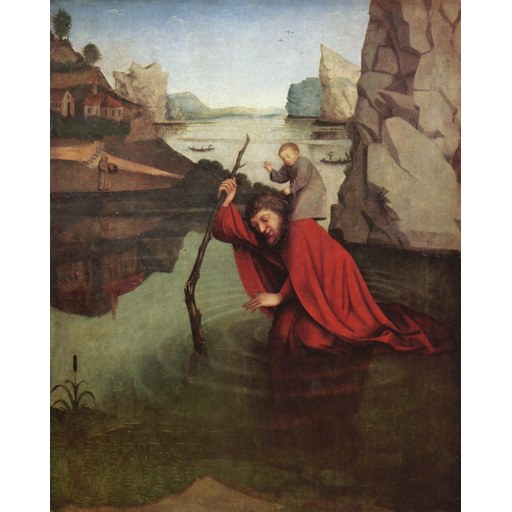
Konrad Witz
License: Public domain
Saint Christopher
Saint- Feast Day
- 25 July (Western Christianity); 9 May (Eastern Christianity)
- Gender
- male
- Church
- Catholic


Relics & Where to Venerate
Location unknown
=== Relics === The Museum of Sacred Art at Saint Justine's Church (Sveta Justina) in Rab, Croatia, claims a gold-plated reliquary holds the skull of St
Roles & Family
Patronage
travelers;motorists;sailors;mariners;ferrymen;porters;transportation workers;truck drivers;bachelors;gardeners;fruit dealers;bookbinders;athletes;against lightning;against storms;against hailstorms;against floods;against pestilence;against plague;against sudden death;epilepsy;toothache;holy death;Havana;Saint Kitts;Brunswick;Mecklenburg;Baden;Vilnius
Biography
Saint Christopher is among the most widely venerated saints in Christian tradition, yet virtually nothing about his life can be established from contemporary historical sources. He is generally regarded in later tradition as a martyr of the third century, and a church dedicated to him is attested at Chalcedon by the mid-fifth century, which shows that a cult already existed in the late antique East. Beyond such traces of early veneration, the surviving accounts are legendary. Western and Eastern churches developed distinct narratives, and later medieval writers, especially Jacobus de Voragine in the Golden Legend, shaped the image that became familiar in Latin Christendom: a man of enormous stature who carried the Christ Child across a river. Modern historical scholarship treats the figure as essentially legendary, and the scarcity of reliable evidence was a principal reason for later liturgical changes in the Roman Catholic Church.
In the earlier Greek tradition the saint is often identified with a figure named Reprobus (or Reprebus), said to have belonged to a people called the Marmaritae. Captured and enrolled in the Roman army, he converted to Christianity, refused to sacrifice to the imperial gods, and was put to death. Some Eastern icons depict him with the head of a dog, a motif that may arise from a misunderstanding of the word Canaanite or from older ethnographic legends about cynocephali; this representation remained largely confined to the East. The Western legend, which became dominant from the high Middle Ages, presents Christopher as a seeker after the most powerful lord. After serving a king and then the devil, he is directed by a hermit to serve Christ by carrying travelers across a dangerous river. One day a child whom he carries grows impossibly heavy; the child reveals himself as Christ, bearing the weight of the world, and Christopher, whose name means Christ-bearer, is baptized.
Accounts of his martyrdom vary and cannot be corroborated independently. Some place it in Lycia in Asia Minor during a persecution of the third century, under the emperor Decius or, in other versions, under Maximinus Daia. He is said to have converted soldiers and others by preaching and miracles before being beheaded. None of these details rests on contemporary testimony. Nevertheless his cult spread widely across East and West. Relics were claimed by numerous churches; he was invoked against sudden death, plague, and the perils of travel; and his image, often a giant with the Child on his shoulder, was painted on church walls so that even a glance might afford protection, and later appeared on medals carried by travelers.
In 1969 the revision of the General Roman Calendar removed Saint Christopher from the universal liturgical calendar of the Roman Catholic Church, on the grounds that so little historically reliable information survived. He was not thereby declared never to have been a saint: his name remains in the Roman Martyrology, local calendars may still observe his feast on 25 July, and popular devotion, especially among travelers and motorists, has continued. Eastern churches keep his feast on 9 May. He is invoked as patron of travelers, sailors, ferrymen, and, in the modern period, motorists and other transport workers, as well as against lightning, floods, pestilence, and sudden death. The endurance of his cult illustrates how a largely legendary figure could become one of the most recognizable saints of Christian popular piety.