Saint Colette is a saint of the Catholic Church (1381 - 1447). Saint Colette's feast day is celebrated on 6 March. Saint Colette is the patron saint of women seeking to conceive;expectant mothers;sick children;against infertility.
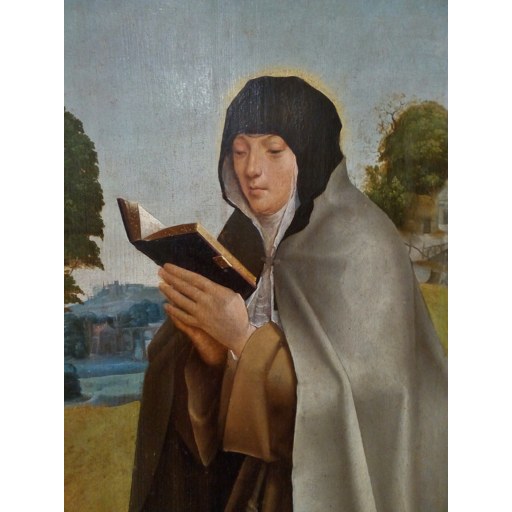
RickMorais
License: CC BY-SA 4.0
Saint Colette
Saint- Life Span
- 1381 - 1447 (age 66)
- Feast Day
- 6 March
- Gender
- female
- Church
- Catholic
Places
Roles & Family
Religious Information
Patronage
women seeking to conceive;expectant mothers;sick children;against infertility
Canonization
Biography
Nicolette Boellet, later known as Colette, was born in 1381 in Corbie in Picardy, in the Kingdom of France. Her father, Robert Boellet, was a carpenter employed by the Benedictine abbey of Corbie; her mother was Marguerite Moyon. The couple had long been childless, and they regarded Colette’s birth as an answer to prayer, naming her after Saint Nicholas of Myra. After both parents died around the turn of the fifteenth century, she disposed of her modest inheritance and sought a religious life. She associated first with the Beguines and then tried the Benedictines and the Urbanist Poor Clares, but found none of these communities austere enough. Received into the Third Order of Saint Francis, she obtained permission from the abbot of Corbie to live for several years as a recluse in a cell adjoining the abbey church.
During that enclosure she experienced visions in which Saint Francis of Assisi and other heavenly figures urged her to restore the Rule of Saint Clare to its original strictness. In 1406 she left her cell and traveled to Nice, where Benedict XIII—the Avignon claimant recognized in France during the Western Schism—authorized her to enter the Second Order, the Poor Clares, and commissioned her to reform existing houses and found new ones according to the primitive observance. Professed as a Poor Clare and appointed abbess and reformer, she began a decades-long restoration that produced the branch later called the Colettine Poor Clares. Assisted by the Franciscan Observant Henry of Beaume, she reformed or founded monasteries in Burgundy, Savoy, and the Low Countries, including houses at Besançon, Auxonne, Poligny, Ghent, Heidelberg, and Amiens. The Colettine reform insisted on absolute poverty, perpetual fasting and abstinence, and the original Franciscan-Clarian constitutions.
Colette’s reputation for holiness, prophecy, and miracles spread widely in the first half of the fifteenth century. She was credited with conversions, healings, and interventions on behalf of the Church during the lingering schism and the early conciliar period. She maintained an austere personal regime of prayer, penance, and governance of her growing network of convents, and she corresponded with contemporary reformers. In her last years she resided principally at the monastery she had established in Ghent, in the County of Flanders. She died there on 6 March 1447 and was buried in the church of the Poor Clares of that house. Relics associated with her were later preserved also at Poligny in the Jura.
Devotion to Colette continued after her death. She was beatified in 1740 by Pope Clement XII and canonized in 1807 by Pope Pius VII. Her feast is kept on 6 March. She is invoked as a patron of women seeking to conceive, of expectant mothers, and of sick children, associations that reflect both the circumstances of her own birth and miracles attributed to her intercession.