Saint Constantine is a saint of the Catholic Church. Saint Constantine's feast day is celebrated on 9 March; 11 March.
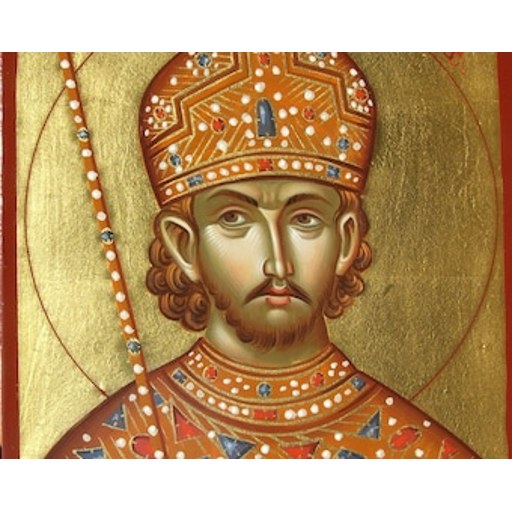
https://www.etsy.com/listing/1860220485/saint-constantine-icon-handmade
License: unknown
Saint Constantine
Saint- Feast Day
- 9 March; 11 March
- Gender
- male
- Church
- Catholic
Places
Roles & Family
Biography
Saint Constantine is remembered as a sixth-century king of Dumnonia in southwestern Britain who later entered the monastic life and was honoured as a martyr, especially in Cornwall and on the west coast of Scotland. Almost nothing about him can be established from contemporary evidence. No source records his year or place of birth, and the year of death sometimes given in later martyrologies, 576, is traditional rather than demonstrable. Modern scholars generally hold that the medieval dossier combines at least two, and possibly three, figures who shared the name Constantine: a historical king of Dumnonia, a Cornish monastic founder, and a missionary killed in Kintyre.
The only sixth-century witness is Gildas, whose De Excidio et Conquestu Britanniae, written around the middle of the century, denounces a Constantine, ruler of Dumnonia, as a tyrant. Gildas charges him with perjury, with putting away his lawful wife, and with the murder of two royal youths inside a church, the king having entered the building disguised as an abbot. The passage proves that a king of that name was alive and active in Dumnonia in the 530s or 540s. Whether this man is the same person later culted as a saint is uncertain; medieval writers assumed that he was, and they interpreted the crimes as the dark prelude to conversion.
From the twelfth century, hagiographical and liturgical texts present a different picture. Constantine, after the death of his wife or after a sudden religious awakening, is said to have resigned his crown, received the monastic habit, and submitted to a life of humility, sometimes described as grinding corn in a monastery. Irish tradition links him with Saint Mochuda of Rahan; Welsh and Cumbrian tradition associate him with Saint David or with Saint Kentigern. He then appears as a preacher in Kintyre, in the Gaelic kingdom of Dál Riata. There, according to the legend, he was attacked by pirates or by pagan inhabitants while working in a barn and was put to death. The church of Kilchousland on the Kintyre peninsula and the parish of Constantine in Cornwall both preserve his name and indicate an early cult on either side of the Irish Sea.
A further Constantine, described as a son of Rhydderch Hael of Strathclyde who laid down his kingship to become a monk, has frequently been merged with the Dumnonian figure, as has the important church dedication at Govan. Because these strands cannot be securely disentangled, historians treat Saint Constantine as a composite. His feast is kept on 9 March in Cornish and some English calendars and on 11 March in the Aberdeen Breviary and in Eastern Orthodox usage. He is venerated in the Roman Catholic Church, the Eastern Orthodox Church, and Anglican churches as an ancient saint; there was no medieval papal canonization and no recorded beatification. His cult remained local. He is associated with the Cornish parish that bears his name and with dedications in Devon and Argyll, but he is not reliably documented as patron of any wider cause, profession, or nation.