Saint Conval is a saint of the Catholic Church. Saint Conval's feast day is celebrated on 28 September. Saint Conval is the patron saint of Inchinnan.
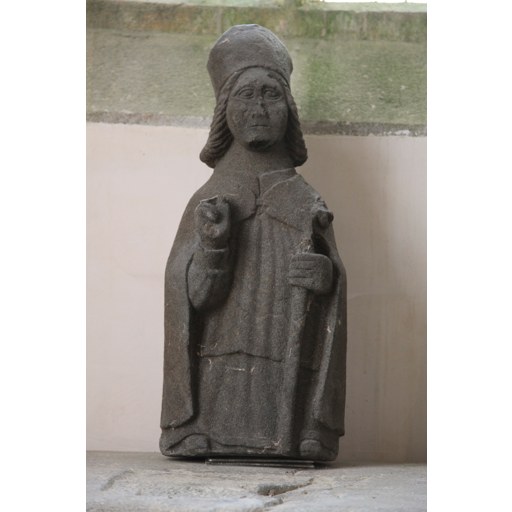
Ggal
License: CC BY-SA 3.0
Saint Conval
Saint- Feast Day
- 28 September
- Gender
- male
- Church
- Catholic
Places
Relics & Where to Venerate
Location unknown
His bones were preserved in an impressive sarcophagus at the Inchinnan church
Roles & Family
Patronage
Inchinnan
Biography
Saint Conval, also known in Latin sources as Convallus and sometimes rendered Conwall or Conval of Inchinnan, is an early medieval saint of Irish origin whose cult was established in the Kingdom of Strathclyde in what is now southwestern Scotland. Later Scottish liturgical books, above all the Aberdeen Breviary of the early sixteenth century, present him as a man of Irish royal or princely birth who left Ireland for the Clyde estuary. Local legend at Inchinnan in Renfrewshire held that he crossed the sea upon a stone, which thereafter remained on the riverbank as a venerated object, often called St Conval's Stone and associated with the so-called Argyll Stone near the old parish church. No contemporary biography survives, and the narrative of his crossing and royal ancestry belongs to later hagiographical tradition rather than to independently documented history.
According to the same tradition, Conval attached himself to Saint Kentigern, also known as Mungo, the missionary bishop associated with Glasgow and the evangelization of Strathclyde. He is described as Kentigern's disciple and as having embraced the monastic life under that influence, and he is frequently styled an abbot. His missionary and pastoral activity is localized in the lower Clyde valley, particularly in the district that became the parish of Inchinnan, where a church was dedicated in his honour. The period in which he lived cannot be fixed with precision; he is generally assigned to the sixth or early seventh century, in the generation of Kentigern, whose own dates likewise rest on later tradition rather than on contemporary record. There is no reliable evidence for a specific year of birth or death, and figures sometimes repeated in older compilations should not be treated as established fact.
Inchinnan remained the centre of Conval's cult. The medieval parish church there was under his invocation, and his relics were said to have been preserved and venerated at that site. Pilgrims and local devotion attached also to the boulder identified as his landing stone. The old church stood near the meeting of the Black Cart, the Gryffe, and the Clyde. Later rebuilding and modern development of the area have altered the landscape, but the dedication and place-name associations survived in local memory and in later church dedications named for St Conval in the wider Renfrewshire and Glasgow region. His feast was observed in the Aberdeen Breviary and other Scottish kalendars on 28 September; some later martyrological compilations instead give 18 May.
The historical evidence for Conval is characteristic of many saints of the early Celtic churches: a name, a place, a feast day, and a cluster of later legends, without a securely dated vita or a charter trail. Recognition of his sanctity belongs to the age of local cultus, long before the papacy reserved canonization to Rome; there is no record of a formal papal canonization or beatification. Modern historians treat the royal Irish origin, the miraculous stone, and the exact relationship to Kentigern as pious tradition rather than as verified biography, while accepting that a holy man named Conval was commemorated at Inchinnan and that his cult was sufficiently established by the later Middle Ages to enter the Aberdeen Breviary and the Scottish kalendars. Beyond that liturgical and topographical footprint, the details of his life remain obscure.