Saint Croidan is a saint of the Catholic Church.
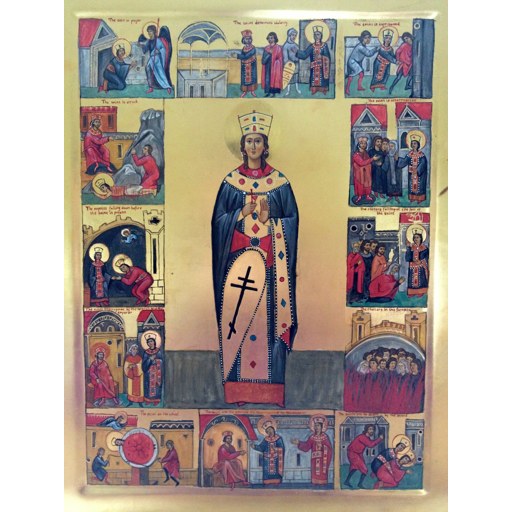
https://katherinesandersicons.com/blog/women-in-icons-saints-and-symbols
License: unknown
Saint Croidan
Saint- Gender
- male
- Church
- Catholic
Places
Roles & Family
Biography
Saint Croidan belongs to the large number of early Irish saints whose names have been preserved in later medieval sources but about whom virtually no contemporary biographical information survives. The early Christian period in Ireland, spanning roughly the fifth through the eighth centuries, produced a remarkable flowering of monasticism and a corresponding abundance of local cults. Many of these holy men and women were commemorated in martyrologies, genealogies, and place-name traditions, yet only a minority received full written lives. Croidan appears to fall into the poorly documented category. He is customarily placed within the Irish monastic tradition of that era.
Irish monasteries of the period functioned as centers of learning, pastoral care, and missionary activity. Figures such as Croidan would typically have been monks or hermits attached to a particular foundation, perhaps serving as an abbot or simply as a revered member of the community. No specific house, however, can be identified with certainty as his. Later hagiographical collections sometimes attach otherwise unknown saints to the circles of famous founders such as Columba of Iona or Ciarán of Clonmacnoise, but such associations are frequently late and unhistorical. No reliable contemporary or near-contemporary vita exists that would allow these connections to be tested.
No reliable date of birth or death has been recorded for Croidan. Likewise, neither his precise place of origin nor the location of his death or burial can be established from surviving evidence. Irish saints of this era were often of noble or royal lineage according to later genealogical tracts, yet even this conventional detail is unattested for him. The absence of a surviving life means that no miracles, voyages, confrontations with secular rulers, or missionary journeys can be attributed to him with any confidence. Claims of a sixth- or seventh-century floruit remain conjectural.
Whatever local cult may once have existed around Saint Croidan did not develop into a widespread devotion. He does not appear prominently in the major Roman martyrologies, nor is he verifiably the patron of any well-known church, diocese, profession, or cause. His memory, if it survives at all, is confined to specialized studies of Irish hagiography and to the occasional appearance of his name in comprehensive lists of saints. This obscurity is itself characteristic of much of the early Irish Church, whose documentary record, though rich for a handful of major figures, remains fragmentary for the great majority of its holy men and women.